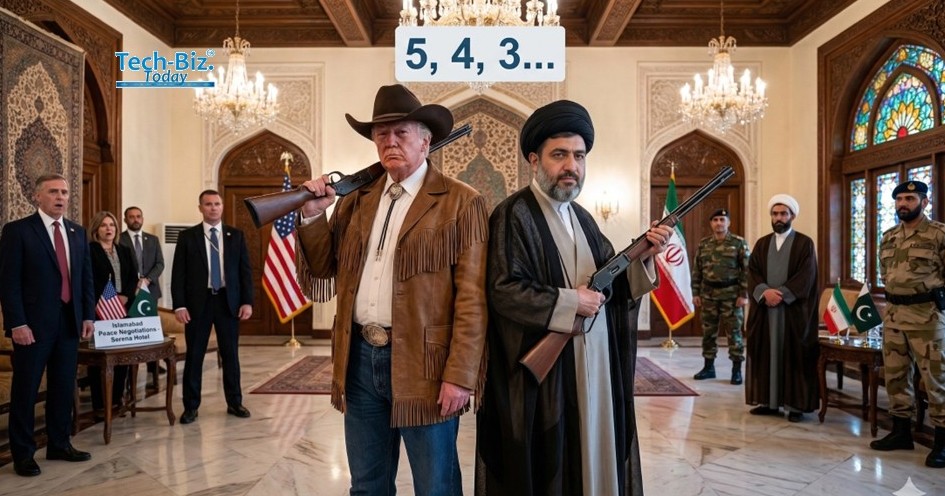
High-stakes US-Iran negotiations have commenced today at Serena Hotel Islamabad, marking a critical and closely watched moment in diplomacy – No mistake is allowed from both sides | Image Tech-Biz.Today & Gemini.
The silence in the Strait of Hormuz is the most expensive quiet in history. With Brent Crude hovering near $120 a barrel, the “success” of Operation Epic Fury is being debated not in military war rooms, but in the power-starved manufacturing hubs of Europe, or the Kigali markets. What began on February 28 as a joint U.S.-Israeli decapitation strike has devolved into a structural crisis that has pit allies against each other and turned the 2026 U.S. Mid-terms into a referendum on global stability.
The Duel of Destinies: Trump vs. Mojtaba
At the heart of the negotiation are two men who have never met but whose mutual contempt is the primary obstacle to peace. President Donald J. Trump enters these talks viewing Iran not as a sovereign nation, but as a “distressed asset” in need of radical restructuring.
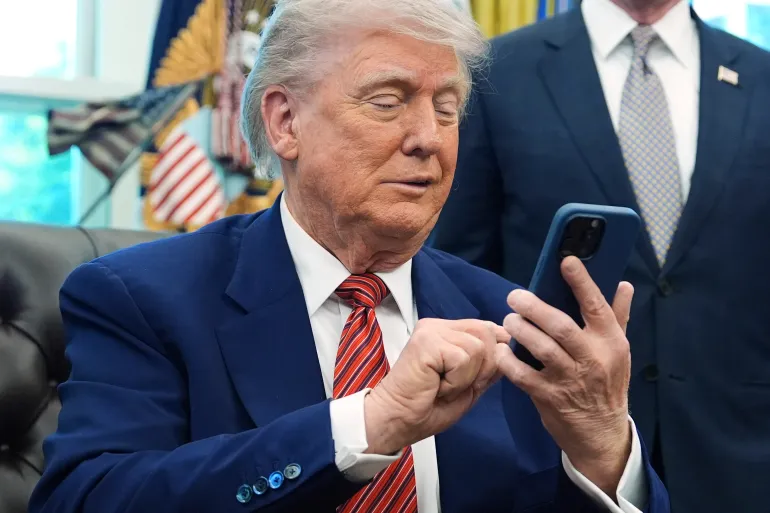
On April 5, 2026, US President Donald Trump issued an expletive-laden threat to Iran, asking it to reopen the Strait of Hormuz [File: Evan Vucci/AP Photo/AlJazeera]
His rhetoric toward the Iranian leadership remains a blend of profanity-laced threats and transactional arrogance. On April 5, Trump signaled his impatience with the negotiation pace, posting on Truth Social: “Open the F***** Strait, you crazy b*******, or you’ll be living in Hell – JUST WATCH!”* (Source: Al Jazeera, “How Iranian Embassies Mocked Trump,” April 7, 2026). Trump views the Iranian leadership as a fractured group of “bad managers” who have let a great country go to ruin, and he believes his personal brand of “Maximum Pressure 2.0” is the only thing capable of forcing a surrender.
Opposing him is Ayatollah Mojtaba Khamenei, the shadowy successor who transitioned from the IRGC’s “shadow man” to Supreme Leader in the vacuum of the March strikes. Mojtaba is a creature of the security apparatus, and his view of Trump is tactical rather than ideological.
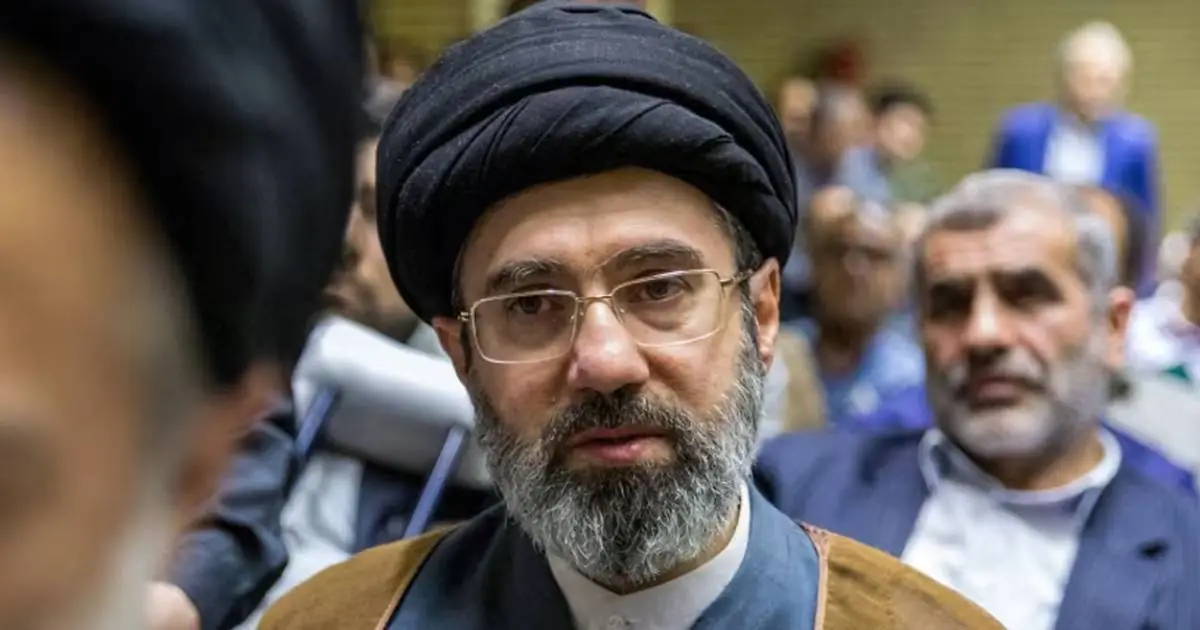
Ayatollah Mojtaba Khamenei, the shadowy successor who transitioned from the IRGC’s “shadow man” to Supreme Leader in the vacuum of the March strikes | Photo CNN/Reuters
He sees the American President as a “vulnerable merchant” whose primary weakness is the U.S. domestic economy. In his first chilling address after the ceasefire, Mojtaba vowed that the “enemies will not go unpunished” and warned that there would be “no mercy on Trump” for the assassination of the previous guard. (Source: Times of India, April 10, 2026). By moving the Strait of Hormuz blockade into a “new phase” of selective targeting, Mojtaba is betting that American voters will tire of $7.00-per-gallon gas before the IRGC tires of life in the bunkers.
The NATO Fracture: A Blueprint for Africa
Perhaps the most shocking outcome of Epic Fury has been the open defiance of NATO’s European core. In a move that has stunned Washington, France and Spain led a contingent of allies in refusing to support the U.S. campaign, going as far as closing their airspace to American bombers and blocking military supply flights to Israel. (Source: Boston 25 News, “Trump Criticizes European Allies,” March 31, 2026). Spanish Prime Minister Pedro Sánchez has been the most vociferous, comparing the conflict to “playing Russian roulette with the destiny of millions” and stating flatly that Spain would “not be complicit in something that is bad for the world… simply out of fear of reprisals.” (Source: The Guardian, March 4, 2026).
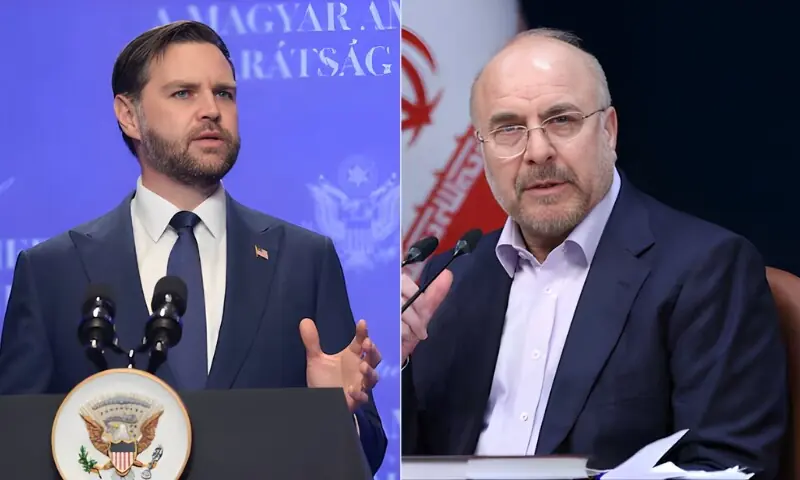
Top Negociators: JD Vance Right, Donald Trump’s US Vice President, Left And Mohammad Bagher Ghalibaf (Speaker of the Majles, Iranian Parliement) Right | Photo AAJ.TV
French President Emmanuel Macron echoed this sentiment, warning of “grave consequences” and signaling that European “strategic autonomy” is now a matter of survival. This refusal to “follow like a dog” behind a U.S. President “full of himself” provides a profound inspiration for African nations. It suggests a new model where middle powers reject the “proxy” role and instead demand neutrality to protect their own economic corridors, such as the digital “AI Factories” currently scaling across the continent. Trump’s response to this European defiance has been characteristic: “Go get your own oil!” he fumed on social media, telling allies to “start learning how to fight for yourself.” (Source: Military Times, April 9, 2026).
The Israel-Washington Nexus: Convergence and Fission
While the U.S. and Israel launched the war as a unified front to dismantle Iran’s nuclear breakout, their interests are now in sharp divergence. Both sought the destruction of Iran’s nuclear enrichment sites—an objective the White House claims has been “very close” to achieved. (Source: Atlantic Council, “Trump’s Path Forward,” April 1, 2026). However, Israel’s objective is existential and total. For Prime Minister Netanyahu, the war is a failure unless the “regime” itself is fully incapacitated, including its hold over Southern Lebanon.
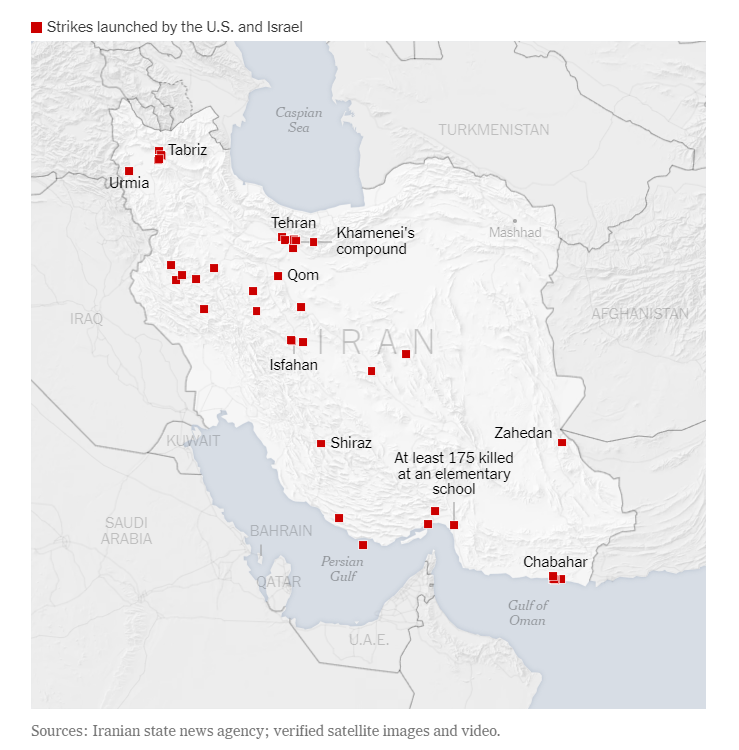
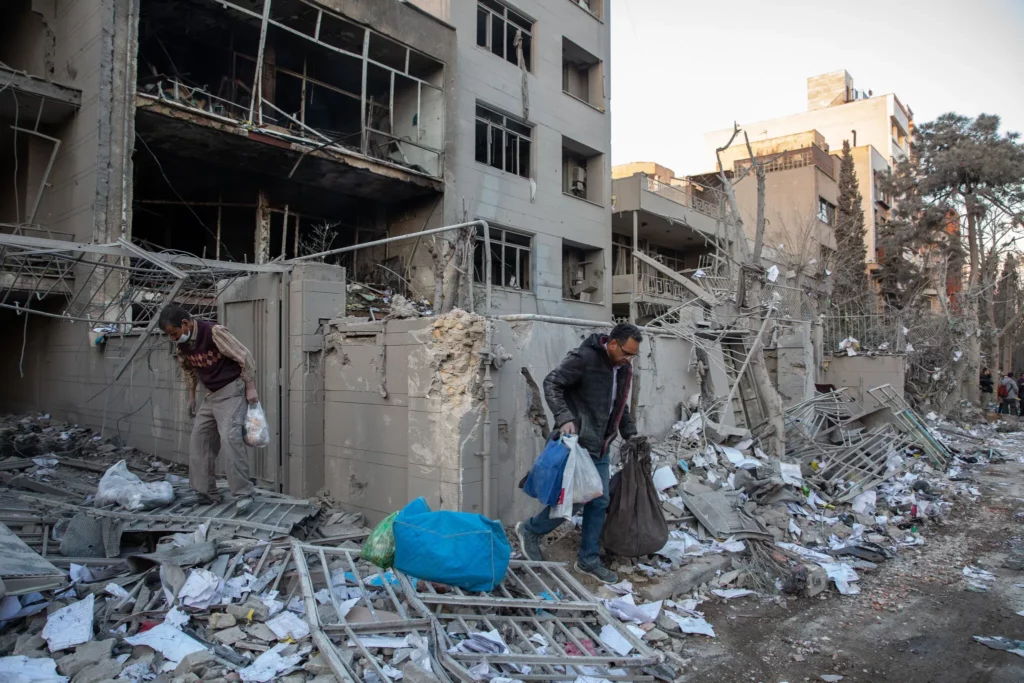
Israel and Us Strikes on Iran (Left); Strikes from Iran (Right)
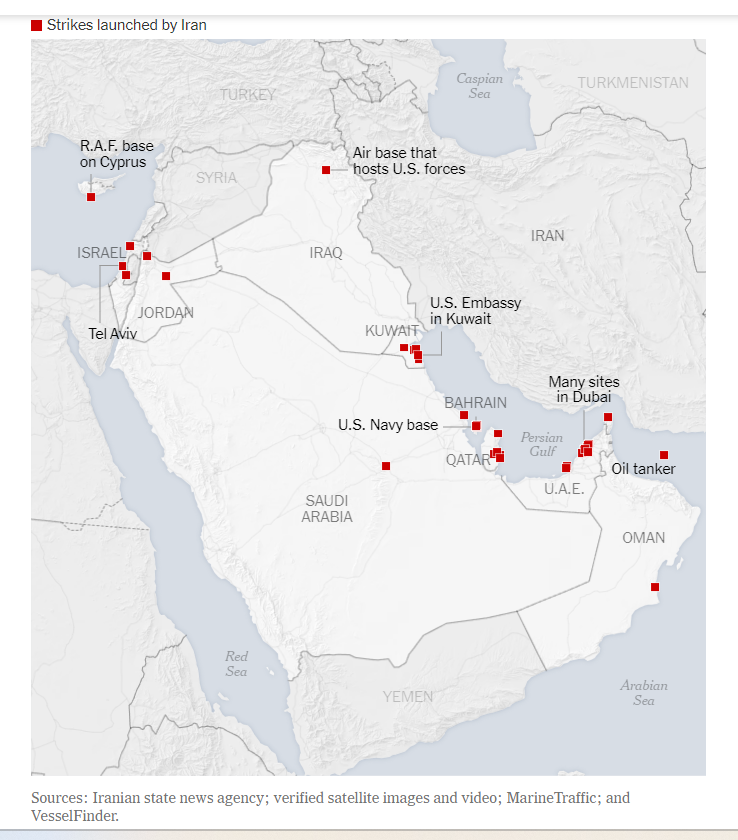
Washington, conversely, is desperate for an “off-ramp” to stabilize global markets. This has created a friction point where the U.S. negotiators—led by Vice President JD Vance and Jared Kushner—are pressuring Israel to accept a “stability-first” model that leaves a wounded but intact Iranian state, a prospect the Israeli security cabinet views as a strategic half-measure.
Domestic Fallout: The Mid-Term Shadow
Inside the U.S., the economic cost of the war is reaching a breaking point. Data released on April 10 shows inflation soaring to 3.3% in March, driven by a 21.2% spike in gasoline prices. (Source: The Guardian, “US Inflation Soars in March,” April 10, 2026). This has triggered a rebellion in both the House and Senate. Democrats are weaponizing the data to frame the war as a “tax on the working class,” while “America First” Republicans are questioning why the U.S. is footing the bill for a Middle Eastern war while the Strait remains closed. With consumer confidence at an all-time low, the White House knows that a failure in Islamabad could lead to a total loss of legislative power in the November mid-terms.
Verdict: Mission Accomplished or Problem Multiplied?
Have the real motivations of the war been obtained? If the goal was the tactical delay of the nuclear program, the answer is partly yes; the bunkers in Natanz and Fordow have been razed. (Source: Joint Chiefs of Staff, April 8, 2026). However, if the goal was regional stability or the end of the “Iran Problem,” the objectives have largely failed. The war has turned the Strait of Hormuz into a permanent friction point and radicalized the IRGC under the iron fist of Mojtaba Khamenei, creating a more militarized and less predictable adversary than his father.
Prospective: The Probability of an Accord
The Probability of Success (25%): A successful accord requires Trump to settle for a “Nuclear Freeze” rather than “Regime Change,” and for Mojtaba to accept a “Managed Sovereignty” where the IRGC retreats from the headlines in exchange for the return of oil revenues. This relies on the personal pragmatism of civilian negotiators like Mohammad Bagher Ghalibaf (Speaker of the Majles) over the ideological demands of their superiors.
The Probability of Failure (75%): The structural state of the Iranian economy is so dire that any concession might look like a surrender, triggering a domestic coup.
Simultaneously, Trump’s penchant for “walking away” if the deal isn’t “perfect” makes a breakdown likely. If the talks collapse, the global economy faces a “Lost Decade” of high energy costs and a permanent shift toward a bifurcated trade system between the West and a Russo-Chinese-Iranian “Shadow Bloc.”