

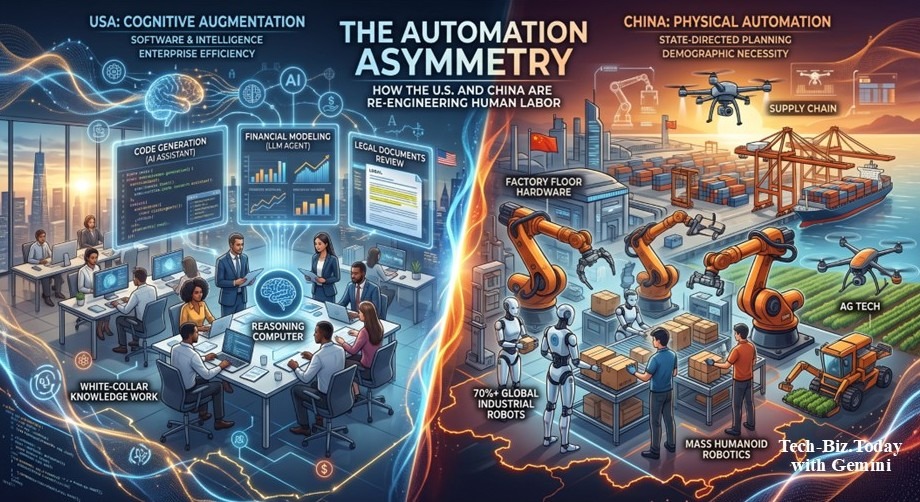
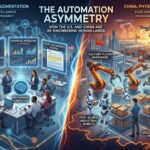
The rapid integration of artificial intelligence and robotics into the global economy has exposed a profound structural divide between the world’s two largest superpowers. While both the United States and China are aggressively automating their production capabilities, they are approaching the transformation from opposite ends of the economic spectrum.
Washington’s strategy is driven by software development, corporate efficiency, and cognitive augmentation designed to streamline white-collar knowledge work. In contrast, Beijing’s strategy is shaped by demographic necessity, state-directed industrial planning, and hardware integration targeting physical labor across factory floors, agricultural fields, and supply chains.
Demographic Survival versus Enterprise Efficiency
China’s aggressive deployment of automation is fundamentally a demographic rescue mission. Facing a shrinking working-age population and low birth rates, Beijing confronts an acute structural shortage of manual labor. Furthermore, as university graduation rates soar across the country, younger generations are increasingly reluctant to take low-wage, physically grueling factory or agricultural jobs. Autonomous machinery and industrial robots are not displacing willing human workers; rather, they are filling an escalating physical vacuum to keep the nation’s industrial foundation operational.
The American drive toward artificial intelligence is catalyzed by free-market competition and capital allocation. Supported by a flexible labor market and steady demographic inflows, the U.S. private sector deploys AI primarily to expand corporate profit margins, reduce operational overhead, and accelerate business workflows.
Left unchecked, however, this extreme automation drive risks destabilizing both society and the economy.
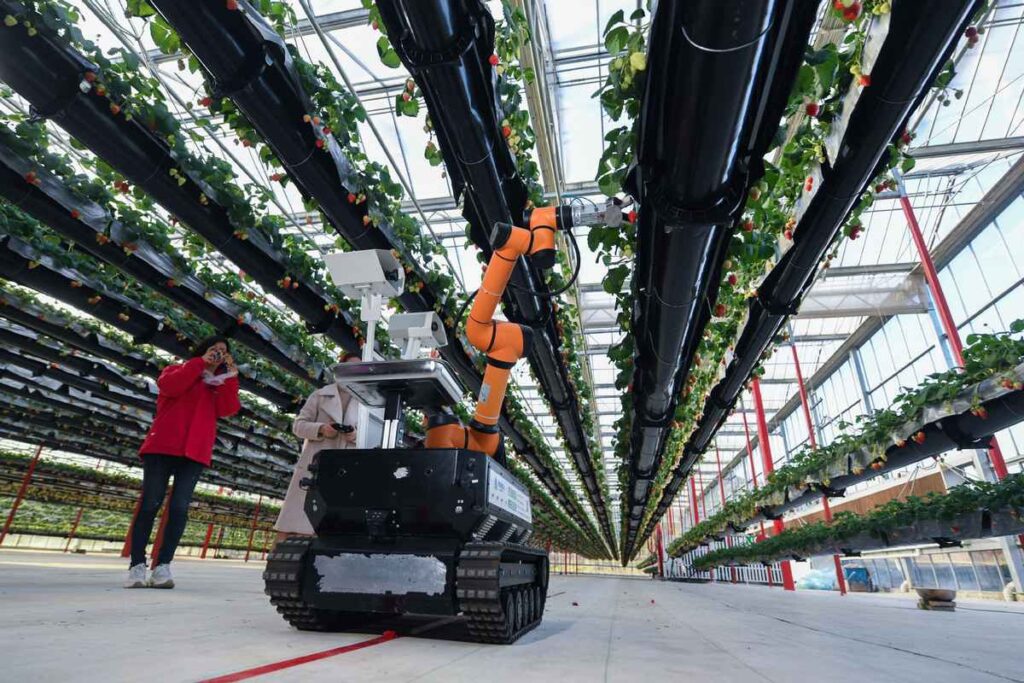
A robot picks strawberries at a strawberry greenhouse in Jiande city, South China’s Guangdong province, Jan 9, 2021. [Photo-Xinhua]
As said “Andy Jassy, CEO of Amazon, speaking during an internal company meeting in September 2025:
“It’s hard to know exactly where this nets out over time, but in the next few years, we expect that this will reduce our total corporate workforce as we get efficiency gains from using AI extensively across the company,” The Economic Times.
Assembly Lines versus Office Desks
“By 2025, China’s robotics industry is set to become a global center of technology innovation, high-end manufacturing, and integrated applications. … The current intensity of industrial robots [is expected] to be doubled.” From the “14th Five-Year Plan for the Robotics Industry,” issued by China’s Ministry of Industry and Information Technology and other departments. (Reported by China Justice Observer, February 2022).
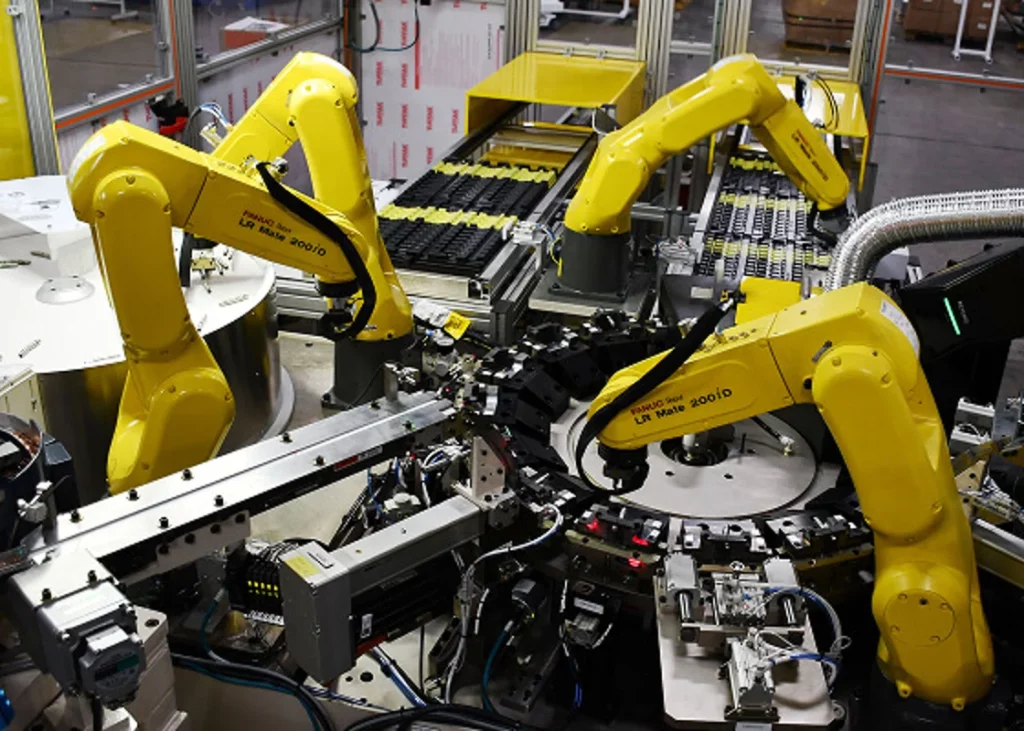
China has systematically concentrated its automation investments in the physical world. The country currently accounts for over seventy percent of all annual global industrial robot installations and commands roughly eighty percent of worldwide humanoid robot shipments. From fully automated container ports in Shanghai to robotic harvesters and factory-floor humanoids, Chinese engineering is focused on automating physical tasks such as welding, sorting, hauling, assembling, and farming.
The United States leads the world in cognitive software automation. Instead of deploying physical humanoid robots across assembly lines, American tech firms integrate autonomous software agents directly into enterprise networks. Generative artificial intelligence systems and specialized autonomous agents are taking over code generation, financial modeling, legal document review, customer service management, and preliminary medical diagnostics. Physical robotics in the U.S. remains focused on high-margin specialized niches, while white-collar digital workflows bear the primary impact of automation.
Upward Mobility versus Cognitive Leverage
China graduates millions of science, technology, engineering, and mathematics students each year. The overarching state objective is to transition human workers out of manual labor and into high-tech research and development, semiconductor fabrication, green technology engineering, education, and advanced services. By delegating repetitive physical strain to robotic systems, Beijing seeks to redirect its increasingly educated human workforce into scientific innovation and complex hardware engineering.
State Stabilization versus Market Flexibility
Because the state plays a central role in economic management, China directs automation with a strong focus on social cohesion. When rapid automation threatens legacy industries like coal mining or traditional steel manufacturing, local governments and state-owned enterprises pace the implementation process. They pair robotic adoption with state-funded retraining initiatives, regional infrastructure investments, and public-sector placements to prevent sudden regional unemployment spikes that could spark social instability.
The American economy relies on market mechanisms to absorb technological disruption. U.S. firms restructure rapidly in response to artificial intelligence advancements, often resulting in swift corporate realignments in non-AI business units alongside aggressive hiring in AI engineering. This creates a highly dynamic and flexible labor environment that relies on market mobility, forcing individuals to adapt quickly to changing corporate demands.
🔗 Sources:
Cet article est également disponible en











Very good article
Thank you for this information