


Paula Ingabire, Minister of ICT and Innovation, Rwanda
A highly strategic, structural shift is unfolding in the heart of East Africa. Following a pivotal Cabinet meeting chaired by President Paul Kagame at Village Urugwiro on 8th May this year, the Office of the Prime Minister officially released a communiqué that marks a fundamental transition in how developing economies approach emerging technology. The formal approval of a standalone National Artificial Intelligence Agency signals that Rwanda is moving past a simple “digital transformation” checklist. Instead, the country is embedding artificial intelligence as a horizontal organizing principle of national governance, state capacity, and economic planning.
Feature by Lucien Usengimana
While many developing nations approach AI through fragmented pilots or reactive regulatory task forces, this structural upgrade elevates governance to a dedicated, centralized state authority. This institutional pivot positions Rwanda alongside a select vanguard of global economies—including Singapore and the United Kingdom—that are centralizing AI oversight to actively manage the complex convergence of data systems, compute infrastructure, and strict sovereign regulatory frameworks.

Launched in April 2nd 2025, the National Health Intelligence Center is a flagship initiative of the Government, designed to integrate cutting-edge analytics and evidence-based insights to harness real-time health data for informed policy decisions and system optimization.
Beyond the Ministry: A New Architecture of State Capacity
The creation of the National Artificial Intelligence Agency represents a direct upgrade from the previous administrative framework. The newly formed agency absorbs and scales up the responsibilities formerly managed by the specialized AI Office within the Ministry of ICT and Innovation (MINICT). By extracting AI governance from the broader ICT umbrella and granting it standalone institutional teeth, the government is signaling that algorithmic systems will increasingly mediate core national operations—ranging from public financial management and urban planning to healthcare resource allocation.
This centralized strategy addresses a historical bottleneck common across the continent: institutional fragmentation. Under the new mandate, the agency will act as the master coordinator across existing regulatory bodies, including the Rwanda Utilities Regulatory Authority (RURA), the National Cyber Security Authority (NCSA), and the Centre for the Fourth Industrial Revolution (C4IR) Rwanda. According to institutional frameworks tracked by The Future Society, this structure allows the state to enforce compliance with Rwanda’s strict Data Protection and Privacy Law uniformly, ensuring that all public and private algorithmic models operate within an ethical perimeter before market fragmentation can take root.
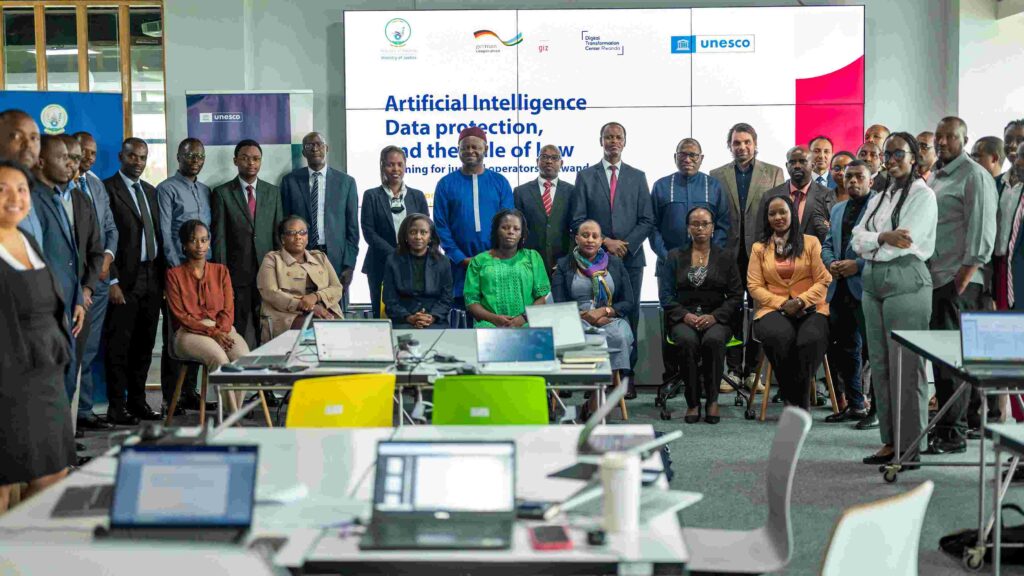
On 14-15 April 26, a Training on AI was held, for Data protection and the Rule of Law for Judicial Operators in Kigali
From the 2023 Blueprint to Boots on the Ground
The agency’s activation is not a sudden pivot, but the calculated execution of a long-term roadmap. The foundations were laid in April 2023 when the Cabinet approved the comprehensive National AI Policy to establish an ethical framework centered on fairness, autonomy, and accountability.
A core philosophy driving this roadmap is an aggressive, intentional focus on human capital over passive technology consumption. The Minister of ICT and Innovation Paula Ingabire explicitly detailed this strategic emphasis during foundational policy rollouts, stating: “When you look at our national AI policy, you realize that 70 per cent of the policy is focused on skills. That was very intentional because we knew that, without the right skills, we would never be able to support the industry and its associated changes.”
This deliberate investment in human architecture aims to foster an ecosystem capable of solving local, contextual problems rather than relying on imported, off-the-shelf digital tools. In a subsequent address on domestic tech incubation, Minister Ingabire reinforced that infrastructure remains ineffective without a deeply capable local developer class, noting:
“We will not be able to build homegrown solutions that respond to local challenges if we don’t have a talented AI ecosystem, people that understand how to build these models, people that are able to leverage these tools and are out there to create the solutions.”
This clear vision for localized expertise was further elevated on the continental stage during the Global AI Summit on Africa held in Kigali, where leaders from 54 nations endorsed the landmark Africa Declaration on Artificial Intelligence. The declaration outlined ambitious cross-border collaborations, including a proposed $60 billion Africa AI Fund, placing Rwanda at the diplomatic and operational center of continental tech orchestration.
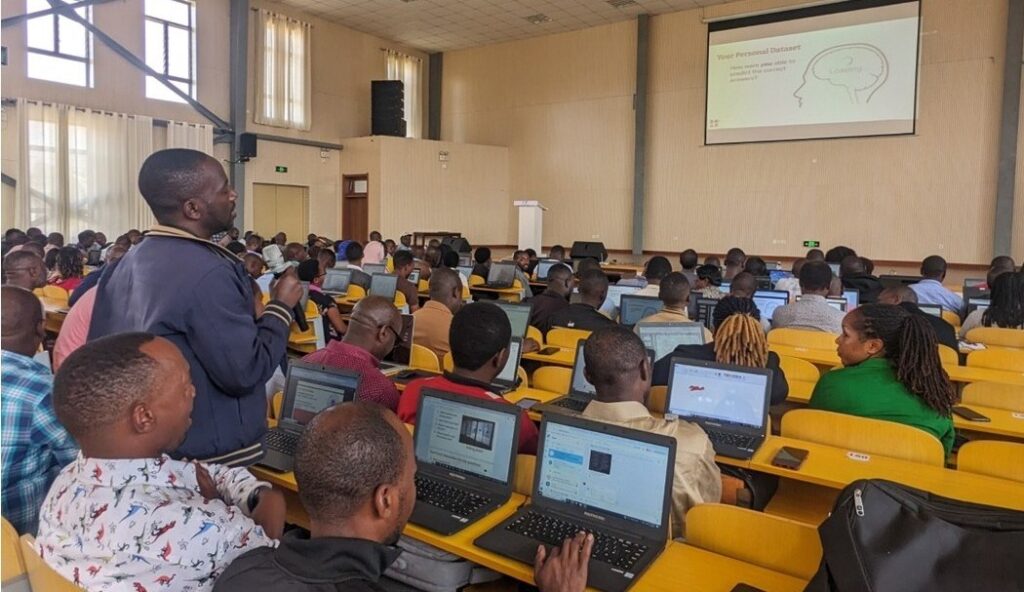
AI Training for Teachers | Mineduc Photo – Dec 2025
The Active Pipeline: AI in Healthcare, Justice, and Classrooms
The practical applications of this institutional readiness are already visible across multiple public sectors. In healthcare, the Ministry of Health, in coordination with the Global Fund, has advanced the implementation of the Health Intelligence Center (HIC). Operating on a sophisticated six-layer data lakehouse architecture, the HIC uses AI predictive models to parse real-time diagnostic data from local community health workers up to national referral hospitals, specifically targeting maternal mortality drivers and precision resource deployment for infectious diseases. Concurrently, as tracked by C4IR Rwanda, clinical triage pilots are deploying localized Kinyarwanda language models to support primary healthcare workers in rural clinics.
In the sphere of civic tech and smart governance, the Ministry of Local Government (MINALOC) and the Rwanda Information Society Authority (RISA) are systematically scaling the Mbaza AI citizen support agent across all 30 districts. This system uses voice-interactive AI in Kinyarwanda to automate citizen grievance tracking and flag financial scams. Parallel to this, homegrown private sector initiatives like Mbaza Ubutabera—developed by local tech collectives—are entering NGO-level deployments, utilizing AI to help citizens and legal students parse complex, scattered Rwandan legal frameworks.
Education presents perhaps the most aggressive short-term timeline in the pipeline. In partnership with the Rwanda Education Board (REB) and MIT RAISE, the state is executing the late-stage rollout of its national AI literacy initiative. The current implementation phase runs directly through the end of the year, with the explicit goal of finalizing the training of over 5,000 “AI Champion” teachers across nearly 2,000 schools. This initiative ensures that basic AI literacy and prompt engineering principles become permanently embedded in the national primary and secondary school ICT curriculums.

Faminga, a rwandan company, uses AI and IoT-enabled soil sensors to deliver insights to farmers, for data-driven decision-making.
Compressing the Developmental Timeline
By creating a standalone entity to orchestrate these moving pieces, Rwanda is attempting what economic historians call “compressing timelines.” Operating under a hybrid developmental model, the state leverages heavy centralized coordination to offset typical structural constraints in capital, infrastructure, and industrial depth.
The National Artificial Intelligence Agency stands as the primary instrument to achieve this leapfrog effect. By defining clean data governance baselines, deploying localized language models, and structurally reforming the national curriculum all at once, Rwanda is actively designing a sovereign computational framework—one intended to prove that an agile African state can effectively govern its own digital destiny.
Cet article est également disponible en













Very good article
Thank you for this information