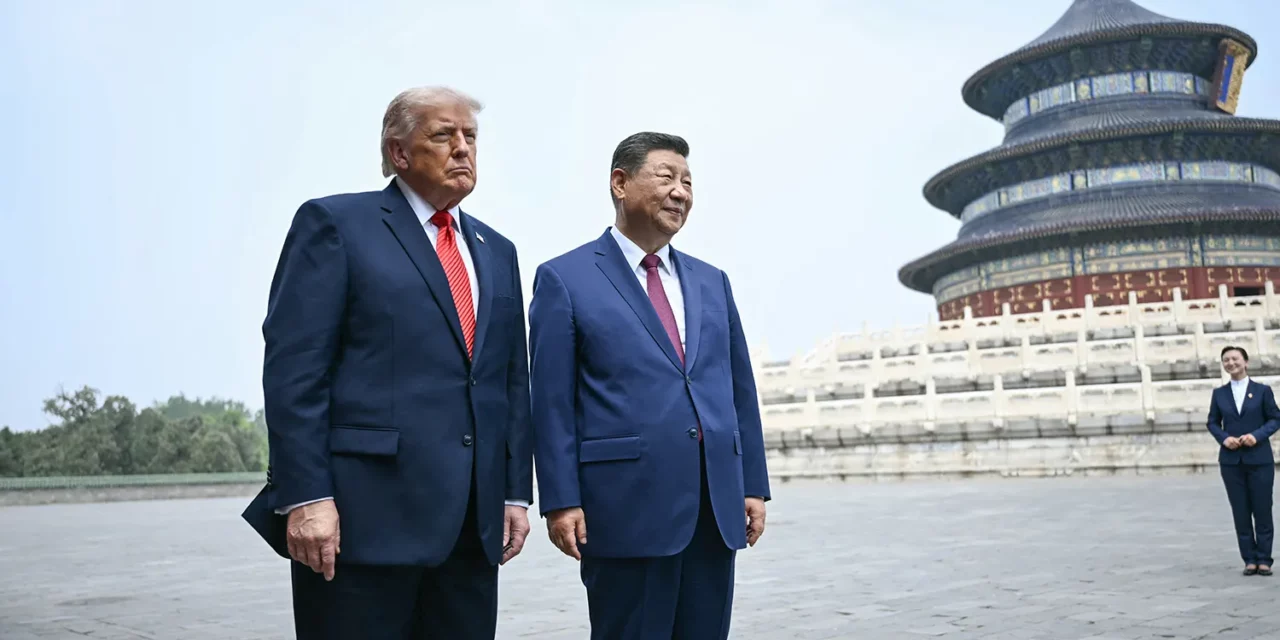
Donald Trump and Xi Jinping standing, during the 14-15 May Summit
From May 13 to 15, 2026, U.S. President Donald Trump’s high-profile state visit to Beijing marked a profound turning point in modern global governance. Behind the gilded halls of the Zhongnanhai Garden and the 21-gun salutes at the Great Hall of the People, this meeting was far more than standard diplomatic choreography.
Postponed from April due to the intense geopolitical shadow of the 2026 war in West Asia, the summit forced a direct confrontational weighing of the world’s two largest superpowers. Above all, it served as a monumental moment of de facto, systemic recognition: Washington has accepted that China is an integrated, equivalent peer superpower capable of either anchoring or completely disrupting American global strategy.
De Facto Peer Recognition and the Bipolar Shift
For an American administration built on a foundational platform of unilateral economic dominance, the very architecture of the 2026 Beijing summit represented an unspoken concession to a bipolar global order. During the opening sessions, Trump’s explicit rhetoric that “the United States and China are the most important and most powerful countries in the world” signaled a fundamental departure from traditional unilateralism toward a clear “G2” dynamic.
This necessity was driven by a clear-eyed understanding of China’s immense economic weight and systemic influence. Washington explicitly recognized that on core global strategies, it can no longer operate in isolation; it requires Beijing’s support to achieve critical objectives, while simultaneously fearing China’s capacity to severely disrupt American policies. This structural reality underpins the entire ledger of requests and concessions exchanged during those intense three days in Beijing.

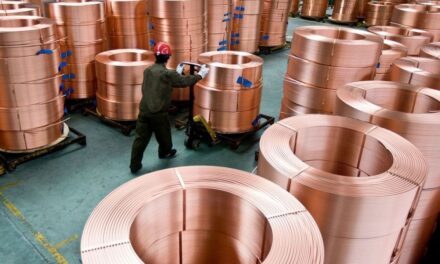
The rare earth minerals, extracted at 60% and refined globaly at 90% by China, at the centre of discussions
The New Playbook: “Constructive Strategic Stability”
For President Xi Jinping and the Chinese delegation, the summit was a long-term game of defensive insulation rather than quick commercial points. Xi successfully guided the Trump administration to formally adopt the core vision of building a “constructive relationship of strategic stability” (World Economic Forum).
This abstract framework provides a managed, three-year blueprint for bilateral ties, effectively shifting the U.S. posture from immediate, volatile decoupling to structured competition (PRC Ministry of Foreign Affairs). For Beijing, locking in this baseline gave the Chinese economy the vital predictability it needed to roll out its newly adopted 15th Five-Year Plan without the looming threat of sudden, unilateral tariff shocks .
The Transactional Ledger: Trophies and Trade Realities
To satisfy Trump’s transactional “America First” metrics, the U.S. delegation pushed heavily for immediate, quantifiable deliverables for American workers and industry.
- The Aerospace Influx: Trump secured a commitment from Beijing to purchase 200 American-made Boeing aircraft. However, international trade analysts observed this fell short of initial U.S. expectations for a blockbuster order of up to 500 planes.
- Agricultural Guarantees: U.S. Trade Representative Jamieson Greer and Treasury Secretary Scott Bessent negotiated commitments ensuring Beijing targets billions in U.S. agricultural goods, translating to a projected $17 billion per year in agricultural and meat procurements through 2028.
- The Institutional Core: Rather than relying on fragile handshakes, the two superpowers permanently institutionalized this trade framework by charting the U.S.-China Board of Trade (to manage bilateral trade across non-sensitive goods) and the U.S.-China Board of Investment.
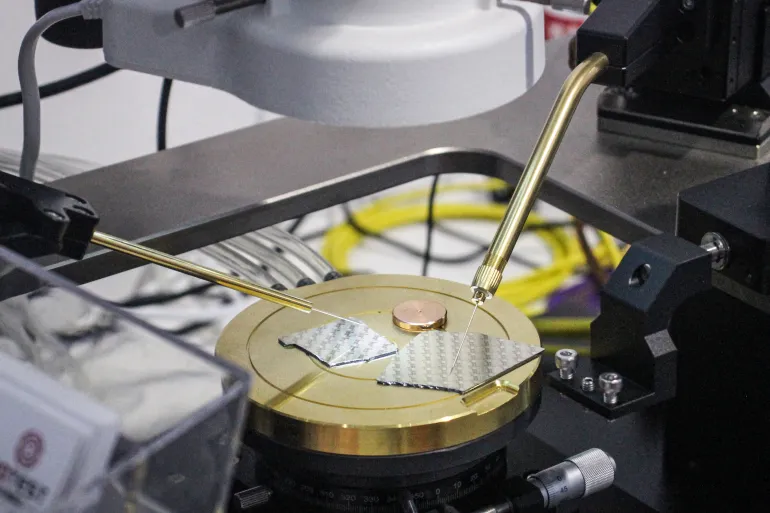
Semiconductor products during the SEMICON – Exhibition in Shanghai – Jing Xuan Teng-AFP | The United States produces approximately 10% to 12% of the world’s physical semiconductor manufacturing capacity. However, when it comes to the overall market—capturing chip design, intellectual property (IP), and global sales revenue—U.S.-based companies command over 50% of the global market.
Chokepoints and Silicon Entourages
The battle over technology re-industrialization was fought in plain sight, emphasized by Trump bringing a delegation of elite American tech titans to the Great Hall of the People, including Apple’s Tim Cook, Tesla’s Elon Musk, and Nvidia’s Jensen Huang.
While the U.S. had quietly greenlit the sale of Nvidia’s second-most powerful AI chip to ten Chinese firms prior to the summit, no deliveries were finalized, and Washington rigidly maintained its core technology blockade, semiconductor export controls, and the U.S. Entity List. However, recognizing China’s capacity to disrupt American high-tech industrial chains, Trump successfully leveraged his positioning to extract critical mineral supply chain guarantees, ensuring steady access to vital heavy rare earths like yttrium, scandium, and neodymium (Source: U.S. Treasury). Concurrently, the two nations agreed to establish a new bilateral protocol to prevent advanced AI models from falling into the hands of non-state actors.
Lines in the Sand: Iran and the Taiwan Stasis
Geopolitical crises highlighted the explicit push-and-pull of mutual support and strategic veto power:
- The Iran Intercession: With the ongoing war in West Asia directly threatening global energy corridors, Trump leveraged Xi’s unique economic line to Tehran. The leaders reached a consensus that Iran cannot be permitted to acquire a nuclear weapon, accompanied by behind-the-scenes contacts that led Tehran to allow specific Chinese vessels safe passage through the critical Strait of Hormuz.
- The Taiwan Red Line: Xi issued his most unyielding warning on cross-Strait dynamics, emphasizing that the Taiwan question is the most sensitive issue and that mishandling it would place the relationship in “great jeopardy”. Trump held the line against any formal policy shift; immediately following the closed-door sessions, U.S. Secretary of State Marco Rubio publicly affirmed to the press that America’s regional security commitments and arms sales posture toward Taiwan remained entirely unchanged.
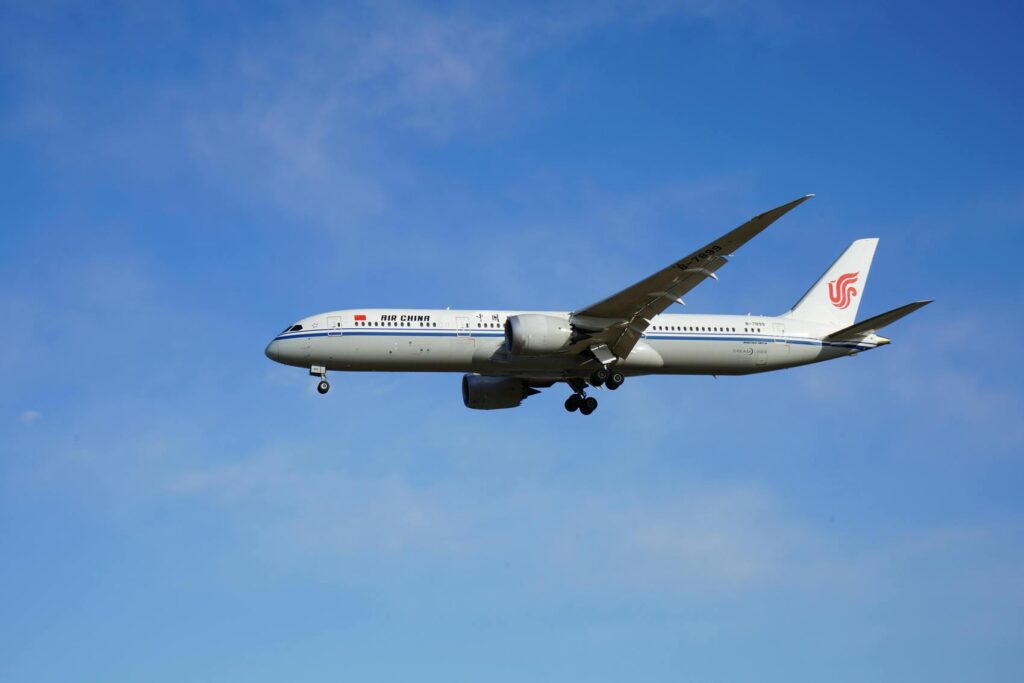
Air China’s Boeing aircraft. Photo Yang Dudu-Pexels | From the Xi-Trump summit, China lifts its suspension on deliveries and will purchase 200 Boeing aircraft.
Navigating the Thucydides Trap: Brakes vs. Structural Gravity
The ultimate question hovering over the Great Hall of the People was structural: Did the summit successfully defuse the Thucydides Trap—the historical phenomenon where a rising power clashes with an established hegemon? In his address, President Xi openly questioned if both nations could create a new paradigm to overcome this historical friction.
Geopolitical strategists note that while the summit did not eliminate the structural gravity of the trap, it effectively institutionalized and managed its risks through executive-level intervention.
The Short-Term Defusal
- The “Principal-to-Principal” Emergency Valve: Historically, Thucydides Trap scenarios spiral due to miscalculations by lower-level military or diplomatic actors. By anchoring the relationship in a highly personalized, transactional dialogue—and scheduling a follow-up summit in Washington this autumn—Trump and Xi ensured that flashpoints will be micro-managed directly from the top.
- Tactical Risk Insulation: The joint alignment on Middle Eastern maritime safety and nuclear non-proliferation demonstrated that both empires are capable of pausing their rivalry when systemic global chaos threatens their mutual baseline economic interests.
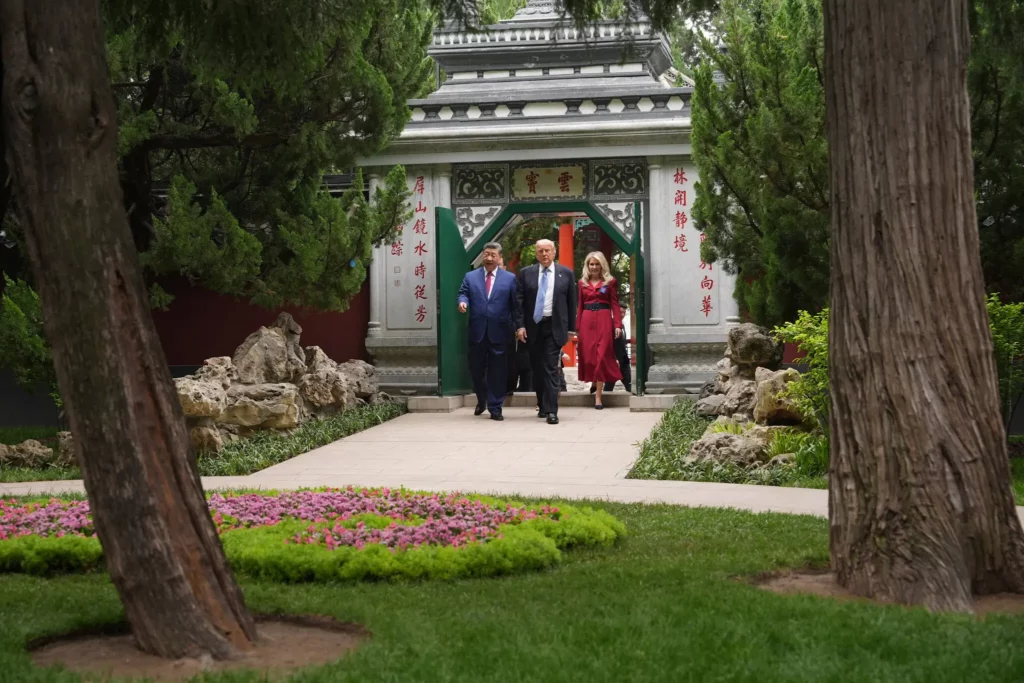
President Trump and the Chinese leader Xi Jinping at Zhongnanhai, the secretive compound where top officials live and work | Photo by Mark Schiefelbein, Nytimes
The Intact Structural Fault Lines
Despite these tactical emergency brakes, the foundational drivers of the trap remain untouched and continue to move forward on parallel tracks. Washington’s refusal to lift its technological blockade proves it has no intention of allowing Beijing to achieve parity in advanced artificial intelligence. Conversely, China is utilizing the newly negotiated “strategic stability” window to aggressively scale up its domestic technological autonomy, insulate itself from Western chokepoints, and build out alternative financial rails like the CIPS and mBridge digital currency networks .
Furthermore, the unyielding status quo over the Taiwan Strait ensures that the ingredients for an explosive, systemic clash remain precisely where they were—temporarily covered by a diplomatic tarp, but entirely unresolved.
The Final Scorecard of Bipolar Equilibrium
The May 2026 summit did not yield a comprehensive, structural grand bargain, but it successfully codified the rules of engagement for a new era of managed bipolar competition. By sitting down as true equals, both leaders protected their most vital strategic lines of defense. Trump returned to Washington with the high-profile economic trophies required for his domestic base. Meanwhile, Xi secured the systemic time and stability necessary for China to continue expanding its independent global influence and technological autonomy. It remains a fragile, highly calculated truce—the defining equilibrium of the world’s most consequential superpower rivalry.