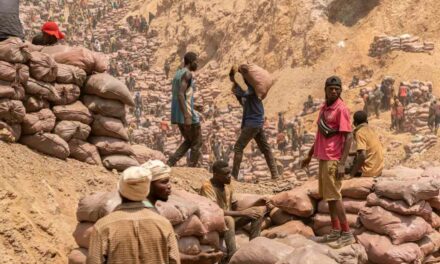
Kamoto Copper Company (KCC) , copper and cobalt mining in Lualaba, DRC, by Glencore (70%), Gécamines (25%), and DRC State (5%)
The Extraversion Trap – Disconnecting Foreign Accords from National Development [1/3]
Under the banner of the U.S.-mediated Washington Accords, the United States and the Democratic Republic of the Congo (DRC) have operationalized a Strategic Partnership Agreement (SPA) designed to grant American capital preferential access to the world’s richest copper, cobalt, and lithium deposits. Following years of dominant Chinese presence across the Katanga copper-cobalt belt, Washington’s commercial entry has mobilized near-unprecedented financial architecture.
The U.S.–DRC Strategic Partnership & Corporate Footprint
To date, three primary U.S.-backed commercial initiatives have established direct operational contracts with the Congolese government and state-owned miner Gécamines:
- Virtus Minerals Consortium: Completed the acquisition of DRC producer Chemaf—a transaction that serves as the commercial vanguard of the SPA framework. Backed by an upfront purchase price of $30 million, $600 million in debt restructuring, and $300 million in site expansion capital, Virtus has gained control over the near-turnkey Mutoshi project and the operational Etoile mine, with combined projected outputs reaching 75,000 tonnes of copper and 25,000 tonnes of cobalt hydroxide annually.
- Orion Critical Mineral Consortium (Orion CMC): Operating as a public-private equity venture backed by up to $900 million in direct U.S. International Development Finance Corporation (DFC) commitments, Orion CMC has entered an MOU to acquire a 40% controlling operational stake in Glencore’s premier mining assets: Mutanda Mining (Mumi) and Kamoto Copper Company (KCC), representing a transaction valuation of approximately $3.6 billion.
- KoBold Metals: The Silicon Valley AI-driven exploration firm, backed by high-profile technology funds, has secured 13 exploration licenses across 3,000 km² in Lualaba and Haut-Katanga, committing over $50 million in initial exploration and statutory licensing fees paid directly to the DRC Treasury.
Crucially, this corporate expansion is underwritten by the Export-Import Bank of the United States (EXIM) through its $10 billion “Project Vault” facility, alongside direct risk mitigation provided by the DFC along the transatlantic Lobito Infrastructure Corridor.
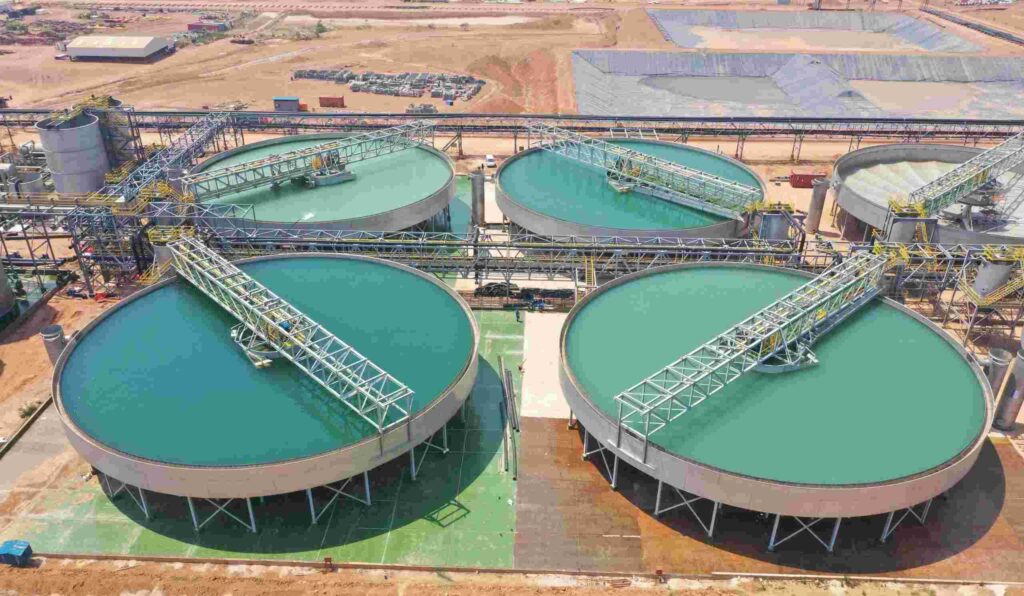
Chemaf – Production of Copper and Cobalt, The Mutoshi pilot projects in Kolwezi, DRC
The “Minerals-for-Security” Architecture: How the Strategic Asset Reserve Operates
At the structural core of these transactions lies a specialized “minerals-for-security” mechanism centered on a designated Strategic Asset Reserve (SAR). Under the terms negotiated between Washington and Kinshasa, the DRC government designates specific unallocated or joint-venture mineral deposits where American firms enjoy:
- A formal right of first offer on unassigned concessions;
- Majority equity terms in partnerships alongside state miner Gécamines; and
- A 10-year tax stabilization window protecting foreign investments from statutory mining duty hikes.
In return, Kinshasa receives diplomatic backing, security coordination via joint monitoring mechanisms, and financial commitments meant to stabilize the country’s eastern borderlands. Proponents argue this structure leverages tier-one Western capital to construct vital transit networks, such as the Lobito Rail link across Angola.
However, critical legal scholars and domestic civil society groups—most notably in constitutional filings before the DRC Constitutional Court—argue that binding a vulnerable state to asymmetric resource commitments compromises national sovereignty, creates unequal tax privileges, and limits future legislative oversight over natural resources.
Internal Visions vs. External Realities: PNSD 2024–2028 and the Subcontracting Imperative
The fundamental risk of the Strategic Partnership Agreement—much like the foreign concessions that preceded it—is the creation of an “enclave economy.” In an enclave model, extractive hubs operate as self-contained islands connected directly to foreign refining hubs via dedicated export corridors, completely detached from the surrounding domestic economy.
“When strategic resource allocations operate outside a country’s internal development roadmap, they risk creating extractive hubs connected directly to foreign markets while remaining detached from the domestic economic fabric.”
This dynamic stands in stark contrast to the DRC’s official national planning frameworks:
- Plan National Stratégique de Développement (PNSD 2024–2028 / Vision 2050): Kinshasa’s master economic plan explicitly mandates a transition away from raw mineral exports toward localized industrial processing, the development of specialized industrial parks (Parcs Industriels), and regional manufacturing.
- Domestic Value Chain & Battery Strategy: Supported by UNECA, the DRC launched the Centre d’Excellence d’Ingénierie des Batteries (CEIB) at the University of Lubumbashi to build in-country capabilities for refining precursor materials for electric vehicle (EV) batteries.
- Local Content Enforcement (ARSP): Under the 2018 Mining Code, the Autorité de Régulation de la Sous-traitance dans le Secteur Privé (ARSP) legally reserves middle-tier services, maintenance, logistics, and engineering contracts for majority Congolese-owned enterprises.
When bilateral mineral accords prioritize immediate raw off-take rights without enforcing mandatory domestic refining or local vendor procurement, they directly undermine the statutory mandates of the PNSD and the ARSP, starving Congolese small and medium enterprises (SMEs) of high-value industrial contracts
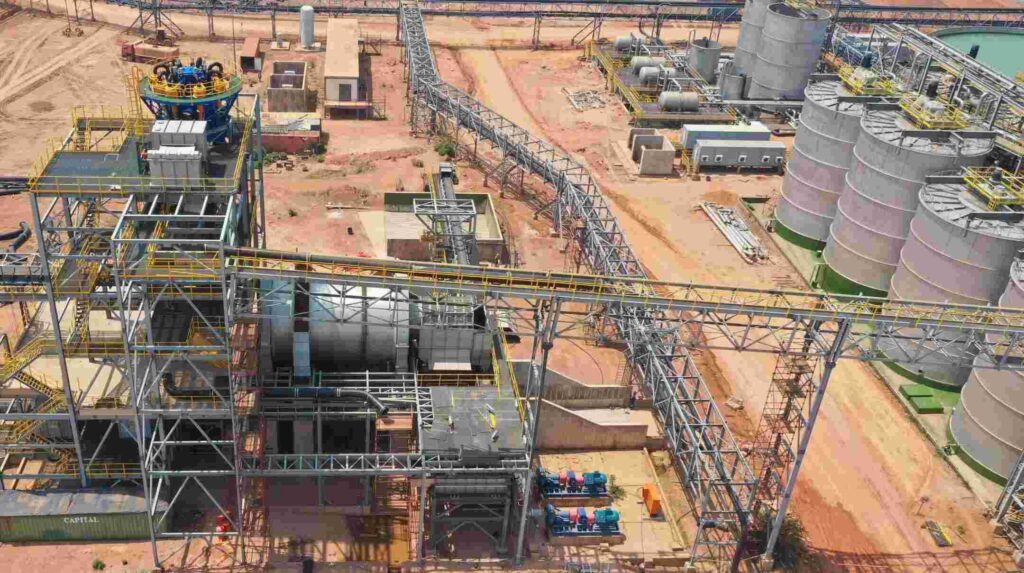
Another view of Chemaf Cie – The Mutoshi pilot project in Kolwezi, DRC
The Chinese Precedent: Lessons from the Sicomines Imbalance
The risks of this extraversion model are not theoretical; they are demonstrated by the DRC’s recent history with Chinese state investments.
Beginning in 2008, the Sicomines “minerals-for-infrastructure” agreement saw a consortium of Chinese state-owned enterprises exchange mining rights for $3 billion in infrastructure loans. While Chinese firms quickly came to dominate an estimated 70% to 80% of Congolese copper and cobalt production, a comprehensive audit by the DRC’s Inspection Générale des Finances (IGF) revealed a profound structural imbalance:
- Fiscal Disparity: Chinese partners extracted over $10 billion in unrefined raw minerals, while delivering only ~$822 million to $1.2 billion in actual completed civil infrastructure.
- Corridor Isolation: Infrastructure projects built under the deal primarily targeted power supply (such as the Busanga Hydroelectric Dam) and transport routes specifically needed to clear bottlenecks for mine exports, rather than expanding rural power access or domestic inter-provincial trade.
- Subcontracting Evasion: Chinese operators routinely bypassed ARSP local content rules by relying on vertically integrated, in-house supply networks and offshore procurement entities, isolating Congolese engineers and service providers from the mining supply chain.
Under this structural model, approximately 90% of raw, unrefined Congolese ore is exported directly to East Asian smelters and refineries.
Consequently, the Democratic Republic of the Congo collects only basic extraction taxes at the source, while foreign processing facilities capture most downstream industrial value.
This disparity forced President Félix Tshisekedi to demand a comprehensive renegotiation in early 2024, eventually securing an updated $7 billion infrastructure commitment. The Sicomines experience underscores a critical lesson: without strict domestic integration, mineral deals become extraction conduits that leave the host nation with depleted soil and unfulfilled infrastructure promises.
Cet article est également disponible en