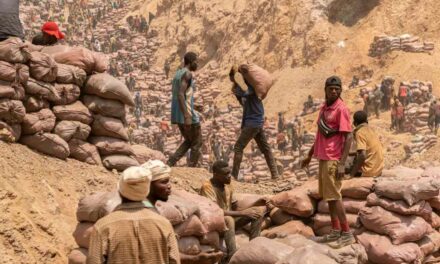
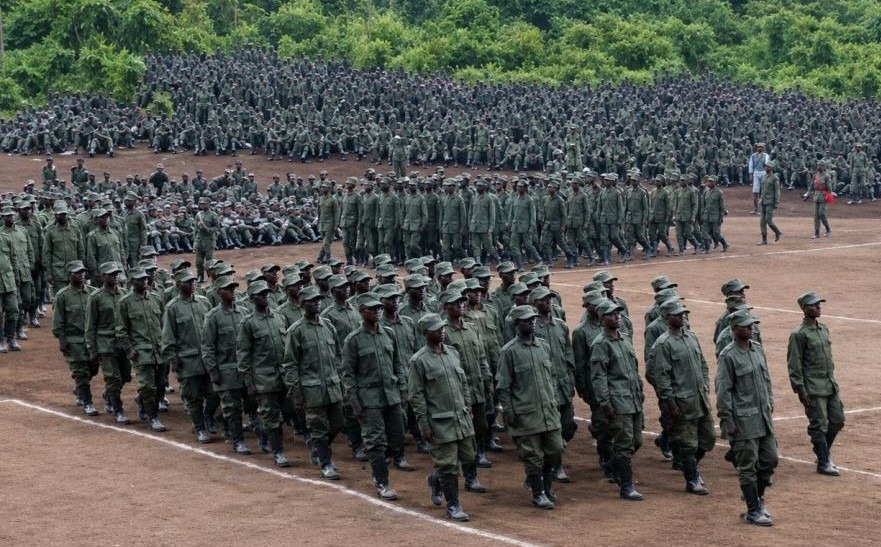
Not so old, more than 15,500 FDLR young fighters operating in total symbiosis with the FARDC and Tshisekedi’s Republican Guard. The reality on the ground, since the advent of Felix Tshisekedi, is far above the numbers given by MONUSCO, minimising them expressly | Photo KT Press
Signed in Washington, D.C., on June 27, 2025, and expanded on December 4, 2025, the Washington Accords for Peace and Prosperity brought Rwandan President Paul Kagame and Democratic Republic of the Congo (DRC) President Félix Tshisekedi together under U.S. President Donald Trump’s mediation. Designed to end decades of wars in the Great Lakes region, the treaty rests on a reciprocal bargain: Rwanda must withdraw its troops from eastern DRC, while the DRC must dismantle the Democratic Forces for the Liberation of Rwanda (FDLR), a militia founded by perpetrators of the 1994 genocide against the Tutsi.
More than a year later, diplomatic architecture is buckling under severe strain. Caught between punitive U.S. financial measures against Kigali, Kinshasa’s unilateral pivot toward relocating rather than neutralizing FDLR fighters, and a major political realignment in Washington following the November 3, 2026 U.S. midterm elections, Rwanda faces a defining scenario: what happens if Kigali walks away from an agreement it views as asymmetrically enforced, versus leveraging an incoming Democratic-led Congress to rebalance the peace process.
The Trigger for an Exit: Asymmetry of Enforcement
The central argument for Rwanda exiting the Accords rests on the uneven application of punitive measures by the treaty’s chief mediator. On October 28, 2026, the U.S. Treasury Department imposed severe sanctions on the Rwandan Ministry of Defence and the Zigama Credit and Savings Society, followed days later by moves to terminate Rwanda’s eligibility under the African Growth and Opportunity Act (AGOA). Washington justified those penalties by citing the deployment of thousands of Rwandan troops across North and South Kivu, joint combat operations alongside the M23, and the supply of advanced weaponry to the rebel movement.
From Kigali’s perspective, such unilateral measures breach mediator neutrality. Rwandan officials observe that while Washington deploys domestic financial and trade statutes to punish Rwanda’s state security apparatus, it has refrained from imposing comparable institutional penalties on Kinshasa despite repeated United Nations Group of Experts reports documenting operational coordination between the Congolese national army (FARDC) and the FDLR, alongside Kinshasa’s reliance on foreign private military contractors. Challenging Washington’s one-sided enforcement in an interview with Radio France Internationale, Rwandan Minister of Foreign Affairs Olivier Nduhungirehe questioned the fairness of the mediation:
“Do you think the Washington agreement is a one-sided agreement that concerns only Rwanda? When it comes to sanctions, only Rwanda is sanctioned. So there is a problem. The bias of the US mediation does not bode well for the effective implementation of the Washington agreement”.
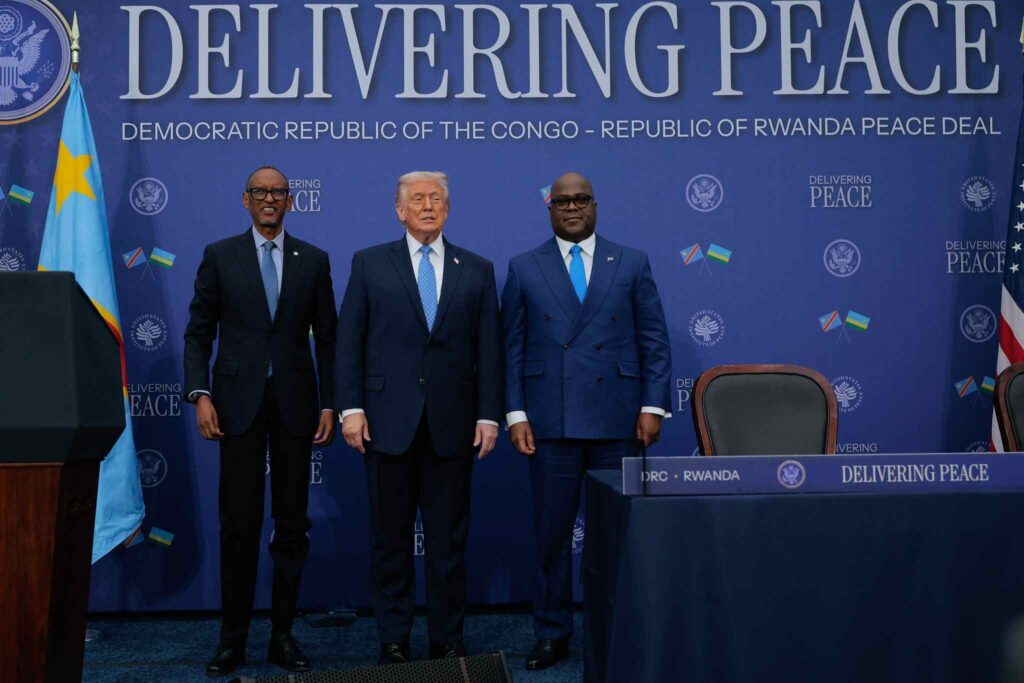
Presidents Kagame, Trump, and Tshisekedi in Washington, just after signing the The Washington Accords for Peace and Prosperity (December 4, 2025) | Photo Chip Somodevilla – Getty Images
The Kitona Relocation Dispute: Negotiating Instead of Neutralizing
Deepening Kigali’s frustration is Kinshasa’s unilateral reinterpretation of its obligation to dismantle the FDLR. Since late July 2026—following controversial outreach involving an FDLR letter and a non-military disarmament protocol—Kinshasa has promoted resettling FDLR fighters who refuse voluntary return to Rwanda in a third African country. Defending that pivot at a July 28, 2026 press briefing in Kinshasa, DRC Minister of Communication and Media Patrick Muyaya rejected military eradication, stating: “Neutralizing the FDLR does not mean killing them.” Addressing the Congolese diaspora in Russia on October 30, 2026, President Tshisekedi announced that authorities were regrouping fighters at the Kitona military base in western DRC pending transfer abroad, only to admit on November 11 that the prospective host nation had backed out.
Rwanda’s objection—that the FDLR is a sanctioned militia subject to neutralisation rather than a negotiating partner—exposes a stark legal and operational gap. Whereas the Washington Accords and their incorporated Concept of Operations (CONOPS) mandate that the FARDC defeat and neutralize the FDLR on a 90-day phased schedule and facilitate repatriation to Rwanda for demobilization or prosecution, Kinshasa’s proposal substitutes open-ended diplomacy without combat.
Four legal and security flaws undermine Kinshasa’s approach. First, one party cannot unilaterally rewrite a core treaty obligation; replacing military neutralization and repatriation with negotiated exile alters the June 2025 bargain without Kigali’s consent. Second, political correspondence and relocation talks elevate a group sanctioned by both the UN and the U.S. Treasury for mass atrocities and child recruitment into a diplomatic interlocutor, potentially shielding 1994 genocide suspects from justice. Third, analysts warn that relocating fighters without dismantling their command hierarchy, political wing, and illicit financing networks merely transplants an intact extremist organization to another African state. Finally, the scheme functioned as a diplomatic stalling tactic: even after U.S. representative Jeffrey Bartos pressed Kinshasa for operational details at an October 13, 2026 UN Security Council session and the International Contact Group on the Great Lakes demanded a timeline on October 30, the aborted effort bought Kinshasa months of delay while Rwanda absorbed U.S. sanctions.
Defenders of Kinshasa’s restraint argue that a full-scale FARDC offensive against FDLR units embedded among civilian refugee communities in North and South Kivu would trigger severe humanitarian fallout and fracture frontlines with local Wazalendo militias. Yet tactical hesitation does not absolve the DRC of its treaty duties. Without compulsory disarmament verified by the Joint Security Coordination Mechanism (JSCM), judicial screening for genocide suspects, and the dissolution of the FDLR’s command structure, Rwanda’s charge that the project subverts the Accords stands on firm ground.
The FRN claims to command an army of 35,000 fighters.
The Economic Fallout: Rubaya Mine and U.S. Mineral Stakes
If Rwanda withdraws from the Washington Accords, the rupture would immediately collide with Washington’s expanding mineral interests in the DRC. The December 2025 Accords incorporated a Regional Economic Integration Framework (REIF) focused on critical mineral supply chains, alongside a bilateral U.S.-DRC Strategic Partnership Agreement granting U.S. buyers a right of first offer on Congolese mineral exports.
At the center of that tension lies North Kivu’s Rubaya coltan mine, a deposit supplying roughly 15 percent of global tantalum that has been controlled by the M23 since May 2024. By tying Congolese mineral access to a U.S.-brokered framework, Washington aligned its supply-chain priorities with Kinshasa’s goal of reclaiming FRN/M23-held territory—a dynamic analysts describe as “externally brokered, mineral-driven peace diplomacy.” A Rwandan exit would collapse the REIF’s regional infrastructure and trade integration pillars, leaving Washington to pursue bilateral mineral security in eastern DRC without Kigali’s cooperation.
What Follows an Exit: Legal Grounds and a Multilateral Pivot
Rwanda’s dissatisfaction with U.S.-led mediation stems from what Kigali views as a persistent pattern of unreciprocated concessions. Should Rwanda withdraw from the Washington Accords, its objective would not be to abandon diplomacy altogether, but to dissolve an asymmetrical framework in favor of a more equilibrated mediation structure.
Peace treaties between sovereign states are governed by the Vienna Convention on the Law of Treaties (VCLT). Under Article 60, a material breach of a bilateral treaty by one party entitles the other to terminate the treaty or suspend its operation. Kigali could cite Kinshasa’s failure to neutralize the FDLR, its push for third-country exile, and its reluctance to operationalize joint REIF commitments as legal grounds for a formal exit.
To correct what it views as the structural flaw of unipolar U.S. enforcement, a Rwandan exit would likely trigger a push for multipolar oversight. Such an arrangement would shift primary authority from Washington to regional blocs—while Washington could remain part of this multilateral oversight, such as the East African Community (EAC), whose member states directly bear the security fallout of the conflict—while introducing competing global guarantors, including BRICS nations and neutral European states, alongside existing observers like Qatar. Broadening oversight would dilute unilateral U.S. sanctioning leverage and subject Kinshasa’s proxy alliances to equal scrutiny.

The Donald J. Trump Institute of Peace Whashington, where met D.J Trump, P. Kagame and F. Tshisekedi in December 2025 for the signing of The Washington Accords
The Post-Midterm Factor: Congressional Oversight in 2027
Before pulling the trigger on withdrawal, Kigali must weigh how the Democratic sweep of both the U.S. House of Representatives and the Senate in the November 3, 2026 midterm elections fundamentally alters Washington’s diplomatic terrain. When the 120th Congress convenes in January 2027, the United States will enter a period of divided government in which Democratic majorities command legislative committees, subpoena power, and federal appropriations, while President Trump retains executive authority over sanctions and foreign policy.
This institutional shift introduces three dynamics into what happens next. First, a Democratic-controlled House Foreign Affairs Committee and Senate Foreign Relations Committee will scrutinize the transactional mineral diplomacy underpinning the administration’s DRC policy. Building on a pre-election warning from 54 House Democrats that U.S.-DRC critical minerals agreements lacked binding human rights, labor, and anti-corruption safeguards, incoming committee chairs can subpoena State Department and Development Finance Corporation records to examine whether commercial ambitions around Rubaya compromised Washington’s neutrality as mediator, lending unexpected credibility to Kigali’s critique of bias.
Second, Democratic congressional oversight is legally and politically bound to examine the bilateral commitments reaffirmed in the March 2026 joint U.S.-DRC-Rwanda statement.
Lawmakers face mounting pressure from human rights monitors to confront documented Congolese violations, including the FARDC’s November and December 2025 deployment of Sukhoi-25 fighter jets and combat drones (In 2025-26) against Banyamulenge civilians and refugees around Mikenke, Minembwe, and Rwitsankuku, alongside Kinshasa’s ongoing ties to the FDLR and its arming of irregular Wazalendo militias.
Such congressional scrutiny would also expose three decades of documented atrocities perpetrated since 1994 by the FDLR in collaboration with the FARDC, Mai-Mai, Wazalendo, and CODECO militias under the political encouragement of Kinshasa. Disproportionately targeting Batutsi communities in the Kivus and the Bahema in Ituri, these campaigns have encompassed massacres, torture, sexual violence, systematic pillaging, live burials, and acts of cannibalism—all underpinned by the illicit extraction and export of minerals and timber facilitated by FARDC elements, Mai-Mai groups, and complicit Congolese authorities at every level.
The value of the cow plundered in the last 10 years in the Kivus and Ituri alone amount to Usd 1.5 billion.
Using fiscal year 2026–2027 appropriations, lawmakers can place statutory holds on U.S. security assistance and mineral-traceability funds for the DRC until the State Department certifies that Kinshasa has severed those proxy ties.
Third, any expectation in Kigali that a Democratic Congress will unilaterally dismantle the October 2026 Treasury sanctions misreads U.S. political realities. In fact, lacking veto-proof majorities in both chambers—290 seats in the House and 60 in the Senate—Congress cannot revoke executive branch sanctions over President Trump’s objections.
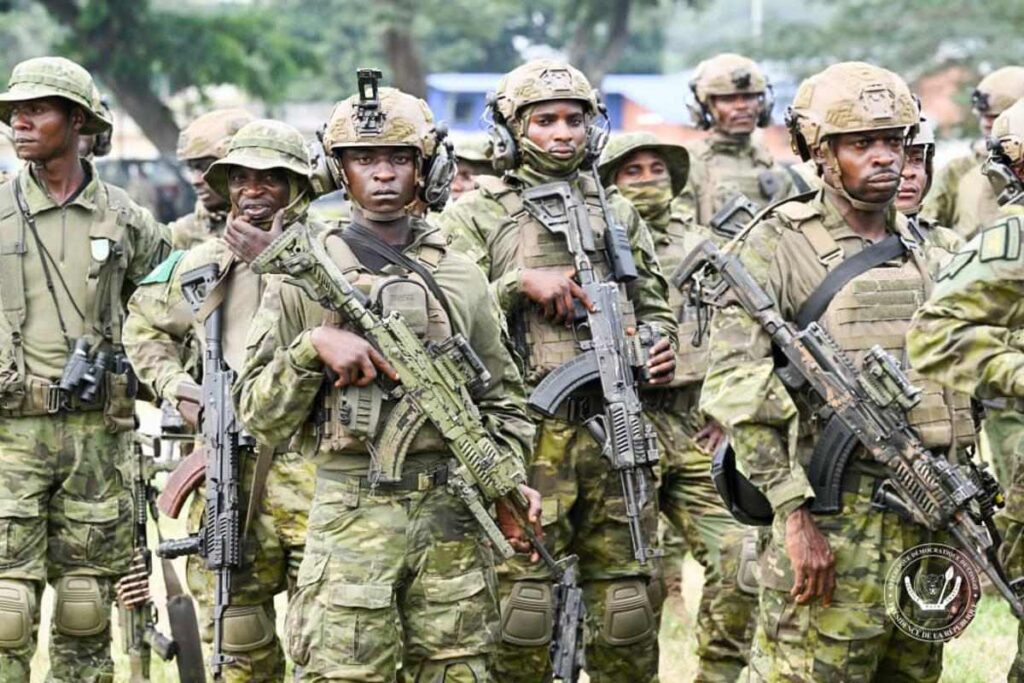
In North Kivu, the FRN simultaneously engaged pro-government Wazalendo and FDLR fighters in Rutshuru territory, where the FRN-aligned outlet Kivu Morning Post reported clashes on November 2 in the Tongo and Bambo groupements of western Rutshuru’s Bwito chiefdom during multi-day operations near Virunga National Park. Brief fighting also broke out along the RP1030 road near the Masisi–Walikale border after the FRN attacked pro-government positions, while Actualite.cd reported FRN drone strikes against Wazalendo and FARDC positions in Minjenje on November 4, followed by renewed clashes on November 7 after an FRN assault in Malemo.
The Geopolitical Bottom Line: Tactical Pause or Formal Exit
Divided government in Washington presents Rwanda’s leadership with a decisive strategic fork in early 2027.
If Rwanda withdraws from the Washington Accords immediately, it risks alienating both the White House and incoming Democratic committee chairs while remaining locked under U.S. Treasury sanctions and AGOA suspension.
Kigali has a narrow diplomatic window to execute a tactical pause.
By presenting documented evidence of Kinshasa’s treaty defaults directly to congressional overseers, Rwanda can align its demand for equilibrated enforcement with Democratic calls for human rights accountability and transparency in DRC mineral deals, building pressure to elevate regional guarantors within the Joint Oversight Committee.
Conversely, foreign policy analysts caution that a president facing hostile legislative oversight may lean harder on unilateral executive instruments where lawmakers cannot easily intervene. If institutional gridlock in Washington leaves the October 2026 sanctions and AGOA suspension intact while Kinshasa faces no comparable accountability, Kigali’s legal case under Article 60 of the Vienna Convention to formally exit the Accords and pursue a multipolar mediation framework will become decisive.
Sources and References
The Washington Accords and Reciprocal Obligations (2025–2026):
Peace Agreements Database (PA-X), Joint Declaration / Washington Accords between the DRC and Rwanda (December 4, 2025);
U.S. Department of State, Joint Statement by the Governments of the United States of America, the Democratic Republic of the Congo, and the Republic of Rwanda on Advancing the Washington Accords (March 18, 2026);
Diplomatic Statements on Mediation Bias and Sanctions:
Modern Ghana / RFI, US shows ‘increasingly blatant’ bias over DRC peace deal, says Rwandan minister (July 2, 2026)
Kinshasa’s FDLR Protocol, Kitona, and Third-Country Relocation Plan (2026):
KT Press, Tshisekedi’s New FDLR Delaying Tactic: Relocation Instead of Neutralization (November 2, 2026).
U.S. Sanctions on Rwanda and Rubaya Mineral Dynamics:
U.S. Department of State, The United States Announces Sanctions in Response to Rwanda’s Destabilizing Activities in Eastern Democratic Republic of the Congo ;
Observer Research Foundation, DRC Mineral Security: The Risks of Private Military Contractors (November 16, 2026).
FARDC Collaboration with FDLR, Wazalendo Militias; and Banyamulenge Bombardments, Massacres, Plundering:
Tech-Biz.Today, Special Report: The Economics of Extinction in the Kivus, DRC (11 January 2026)
Tech-Biz.Today, DRC: The Black Hole of Justice (7 February, 2026)
IGIHE, UN report details FDLR’s structure, numbers, and cooperation with FARDC (July 3, 2026)
Taylor & Francis Online, Under the shadow of violence: are the Banyamulenge experiencing a slow genocide? (21 March 2024)
The November 2026 U.S. Midterm Elections and Congressional Oversight:
Institute for Security Studies (ISS Today), A weakened Trump could mean more volatile US policy for Africa (November 9, 2026)