

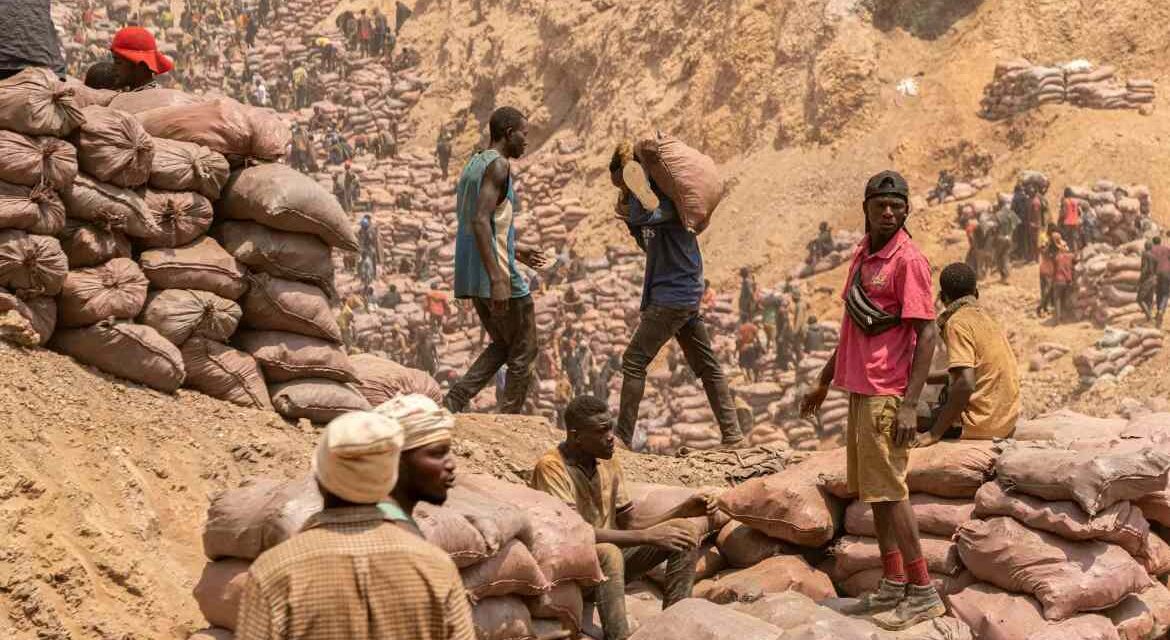
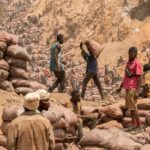
An artisanal miner carries a sack of ore at the Shabara artisanal mine near Kolwezi on October 12, 2022 – Junior Kannah-AFP
Is Tshisekedi Trump’s protégé? [2/3]
Beyond external geopolitical pressures and asymmetric mineral accords, Kinshasa faces a converging three-pronged domestic resistance movement that directly challenges the state’s economic and political legitimacy. This internal counter-front unites moral, political, and grassroots actors who argue that opaque deal-making, executive resource giveaways, and institutional decay are eroding Congolese sovereignty from within. The core question reverberating through political and diplomatic circles is whether President Félix Tshisekedi’s transactional alignment with Western capital has positioned him as Washington’s newest regional protégé, swapping long-term economic autonomy for immediate diplomatic indulgence.
The moral foundation of this internal resistance is anchored by the joint pastoral leadership of the Catholic Bishops Conference of the Congo (CENCO) and the Church of Christ in Congo (ECC). As the nation’s most trusted civic institutions, these religious bodies deliver scathing critiques against systemic electoral fraud, institutional capture, and executive corruption. Their pastoral declarations forcefully condemn constitutional changes and proposed revisions to presidential term limits, warning that bartering sovereign subsoil wealth behind closed doors deprives the state treasury of essential revenue needed for healthcare, education, and basic public infrastructure.
The Domestic Counter-Front: Political Opposition and Human Rights Defenders
Parallel to this moral indictment stands a consolidated political opposition led by prominent figures including Martin Fayulu (ECiDem), Moïse Katumbi (Ensemble pour la République), Delly Sesanga (Envol), Jean-Marc Kabund (Alliance pour le Changement), and former Prime Minister Matata Ponyo. This political front focuses its critique on the structural extraversion of foreign mineral deals, characterizing both U.S.-backed partnership agreements and Chinese barter contracts as an unconstitutional sell-off (braderie) of national sovereignty. They highlight the stark economic asymmetry of granting foreign conglomerates preferential ten-year tax stabilization windows and right-of-first-offer privileges over the Strategic Asset Reserve (SAR) while domestic Congolese enterprises face heavy taxation, administrative harassment, and systematic exclusion from primary mining supply chains. Furthermore, opposition parties forcefully critique the military administration (état de siège) in North Kivu and Ituri, describing it as a governance failure that suspended civil liberties without halting violence, all while enabling military elites within the armed forces (FARDC) to seize control of lucrative trade routes.
On the ground, this domestic front is anchored by established human rights watchdogs and youth citizen movements, including the African Association for Human Rights (ASADHO), La Voix des Sans-Voix (VSV), LUCHA, and Filimbi. Operating across mining hubs in Katanga, Lualaba, and the conflict-distressed eastern provinces, these organizations systematically document the civil and environmental collateral damage of state breakdown. Their field reporting shines a spotlight on shrinking civic space, arbitrary detentions of political dissidents, targeted harassment of investigative journalists, forced evictions of local communities without compensation, untreated environmental degradation, and widespread child labor within unregulated supply chains feeding foreign joint ventures. Crucially, local watchdogs denounce human rights violations committed by regular security forces, state-backed Wazalendo militias, and government-aligned proxies, citing extrajudicial killings, extortion at transit checkpoints, and arbitrary detentions based on facial profiling (faciès) targeting Tutsi and Banyamulenge populations.
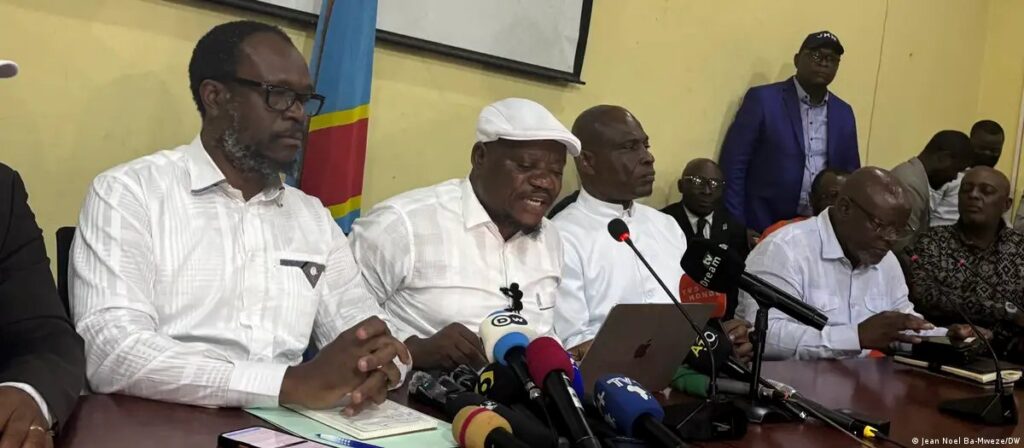
The opposition refuses to back down following the Constitutional Court’s decision validating the law on organizing a referendum. For the Article 64 Coalition, this ruling clears the path for a constitutional revision—a prospect it firmly rejects. In the photo, from left to right: Delly Sesanga (Envol), Jean-Marc Kabund (Alliance pour le Changement), Martin Fayulu (ECiDem) | Photo Jean Noel Ba-Mweze – DW
Top-Down Corruption and the Asymmetric Bargaining Trap
The failure to translate mineral wealth into broad-based domestic development stems directly from persistent institutional vulnerabilities within the Congolese state apparatus. Systemic corruption—occurring at both the executive negotiation level and throughout lower-tier state administration—fundamentally alters the balance of power during international contract negotiations. When executive deal-making takes place behind closed doors without parliamentary oversight, immediate short-term liquidity, political backing, or off-budget patronage considerations take precedence over long-term industrialization mandates.
Foreign negotiators, whether from Beijing or Washington, recognize this institutional fragility and leverage it to secure expansive tax exemptions, majority equity terms, and long-term stabilization guarantees. Once accords are signed, top-down state leakage allows foreign operators to bypass local content laws—such as the mandates enforced by the Autorité de Régulation de la Sous-traitance dans le Secteur Privé (ARSP)—through informal payments, routing lucrative logistics and maintenance contracts to offshore shell companies while mineral rents remain concentrated within elite networks.
Tshisekedi governance deficit is now reaching foreign courts
A legal complaint submitted to the Belgian Federal Prosecutor’s Office by attorneys Bernard and Brieuc Maingain targets nine members of President Félix Tshisekedi’s family and inner circle holding Belgian citizenship, accusing them of systematic corruption, money laundering, and the organized plunder of copper and cobalt concessions across Haut-Katanga and Lualaba provinces.
Filed on behalf of Katangese civil society NGOs and former directors of Gécamines, the court document alleges that vast sums, by billions of Usd, are illicitly diverted monthly from state coffers through parallel extraction networks that rely on the direct support of the military and mining police to secure operations, bypass regulatory checkpoints, and compromise domestic accountability.
Investigative reporting by Tech-Biz.Today has documented a deadly nexus between political elites, military officers, and customary chiefs directly linked to militia creation, who have collaborated to monetize the nation’s subsoil wealth, turning regional concessions into a private family vault. Beyond enriching political networks, this collusion has continuously fueled local militia activity and displaced millions of civilians—a predatory system that predated M23/AFC governance and continues to operate unimpeded across the Ituri region. [Read DRC Plunder: The Washington Mineral deal compromised; How Congo’s Triangle Turns Blood Into Cash Minerals; RDC : ”Le Katanga est devenu le coffre-fort de la famille Tshisekedi”]
Military Routs, Contested Sovereignty, and Rebel Governance
These governance deficits intersect directly with the deteriorating military and humanitarian crisis in eastern DRC. Systemic embezzlement within the defense apparatus has hollowed out the regular armed forces, leaving frontline troops frequently unpaid and under-equipped. To compensate for territorial losses, Kinshasa has assembled a fragmented security coalition integrating local Wazalendo militias, the FDLR, foreign private military contractors from Europe and Latin America, and Burundian military forces—a mix that has fractured the chain of command and complicated regional diplomacy.
The M23 / Alliance Fleuve Congo (AFC) coalition actively leverages Kinshasa’s systemic corruption, bad governance, and state-sanctioned ethnic persecution as parts of the pillars of its political legitimacy narrative. The movement routinely points to targeted violence, arbitrary detentions, mass killings based on facial profiling (faciès), and military collusion between the FARDC, the genocidal FDLR and Wazalendo militias, Burundian forces, foreign mercenaries against Tutsi and Banyamulenge communities to explain its armed campaign.
Crucially, the AFC/M23 frames its localized revenue management as a disciplined alternative to state dysfunction, claiming that direct administrative control stabilizes communities and prevents local populations from falling victims to mass displacement (Organized by the predation of politicians, FARDC and militia); as well as relying permanently on the international aid-NGO complex.
Cet article est également disponible en








Very good article
Thank you for this information