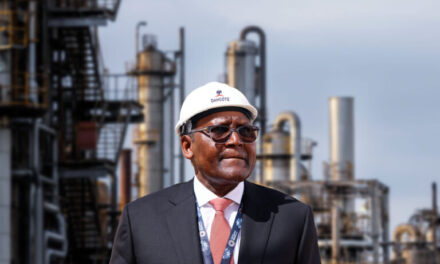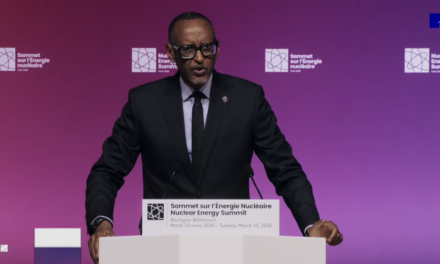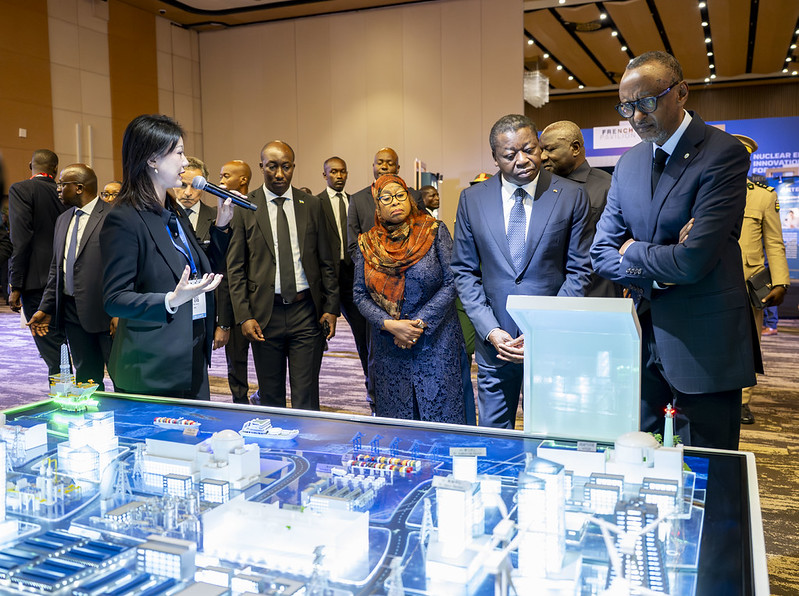
A presentation of the nuclear site by Holtec International to the Presidents (R to L) Paul Kagame of Rwanda, Faure Gnassingbé of Togo, and Samia Suluhu Hassan of Tanzania.
The global race for civil nuclear dominance is unfolding across Africa, but nowhere is the tightrope walk more sophisticated than in Kigali. While major world powers lock horns in a deeply polarized geopolitical landscape, Rwanda has established parallel nuclear cooperation frameworks with both the United States and Russia. Rather than letting the country become a proxy battleground, the government has positioned itself as an open, highly regulated launchpad for advanced energy technology. With a national strategy targeting nuclear energy to anchor its grid by the middle of the century, Kigali is demonstrating how a developing economy can leverage superpower rivalries to achieve sovereign development goals.
The Strategy of Institutional Neutrality
The cornerstone of Rwanda’s ability to manage this high-stakes balancing act is its unwavering reliance on international regulatory guardrails. Instead of negotiating opaque bilateral agreements in a vacuum, the country has anchored its entire nuclear roadmap within the strict frameworks of the International Atomic Energy Agency (IAEA). By successfully completing the early phases of the agency’s infrastructure reviews, Rwanda has signaled to both Washington and Moscow that it operates strictly within standard global safety, security, and non-proliferation benchmarks. This transparency insulates Kigali from accusations of playing favorites, forcing both superpowers to interact with a nation that adheres strictly to multilateral rules.
This institutional readiness marks a point where Kigali’s nuclear roadmap is moving decisively from strategic intent to active deployment. Speaking at the Nuclear Energy Innovation Summit for Africa (NEISA) recently held in Kigali, President Paul Kagame confirmed that the nation is officially on schedule to have operational nuclear capabilities within the next decade, buoyed by positive international benchmarks. By dividing its nuclear ecosystem into distinct functional zones, Rwanda prevents direct operational overlap. Russia’s state-backed nuclear apparatus is utilized primarily to build foundational capacity and academic pipelines, while Western commercial startups introduce cutting-edge, flexible reactor deployments.
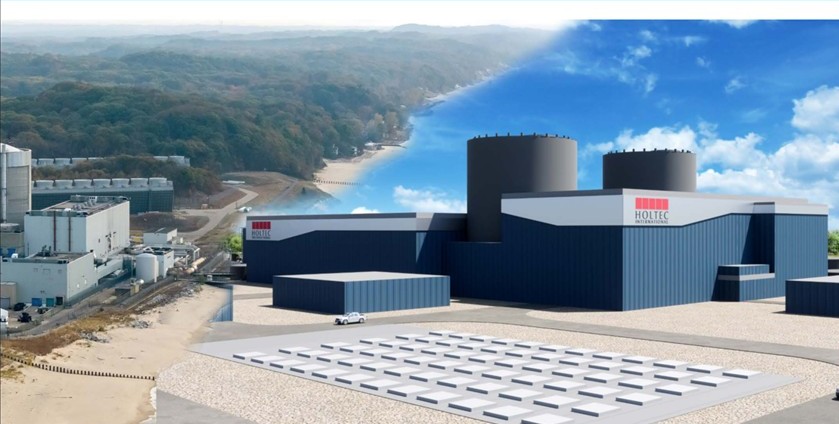
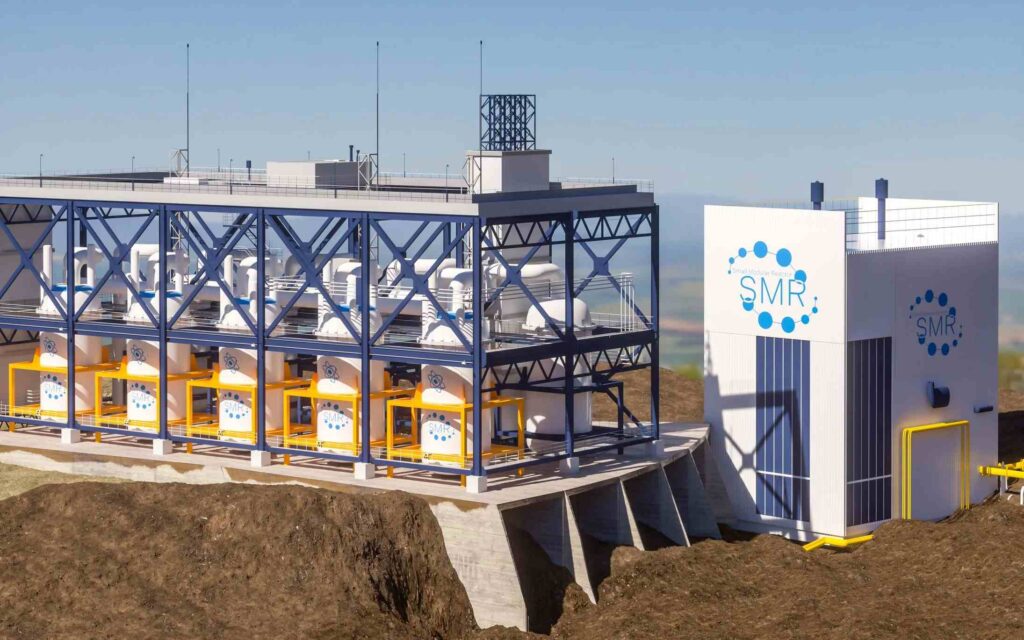
The Model SMR 300 from Holtec International
Diplomacy on Display: The Kigali Convergence
The extraordinary assembly of dignitaries at NEISA Kigali—spanning from regional heads of state like Tanzanian President Samia Suluhu Hassan and Togolese President Faure Gnassingbé to Nigerien Prime Minister Ali Mahamane Zeine, alongside IAEA Director General Rafael Grossi and African Union Commission Chairperson Moussa Faki Mahamat—elevates this movement far beyond standard technical cooperation. This convergence has successfully transformed a deeply polarized global sector into a shared regional venue. By pulling senior U.S. State Department diplomats and commercial innovators like Holtec International into the exact same rooms as state executives from Russia’s Rosatom and the China National Nuclear Corporation, the summit signals a historic shift. Africa is explicitly refusing to become a passive battleground for a new Cold War; instead, it is leveraging intense geopolitical rivalries to actively negotiate its own terms for technology transfer.
The structural importance of this approach lies in its capacity to bridge the chasm between political vision and the hard realities of international finance and regulation. With key delegations from the World Bank, the African Development Bank, and the West African Development Bank working alongside advanced nuclear engineering pioneers from South Korea, Argentina, Great Britain, and the Rwanda Atomic Energy Board, Kigali is constructing the actual blueprints for continental scale. The true legacy of this strategy is a targeted assault on regulatory fragmentation, establishing the foundational frameworks for harmonized cross-border safety standards, regional power grid integration, and innovative public-private project financing to feed an impending industrial revolution.
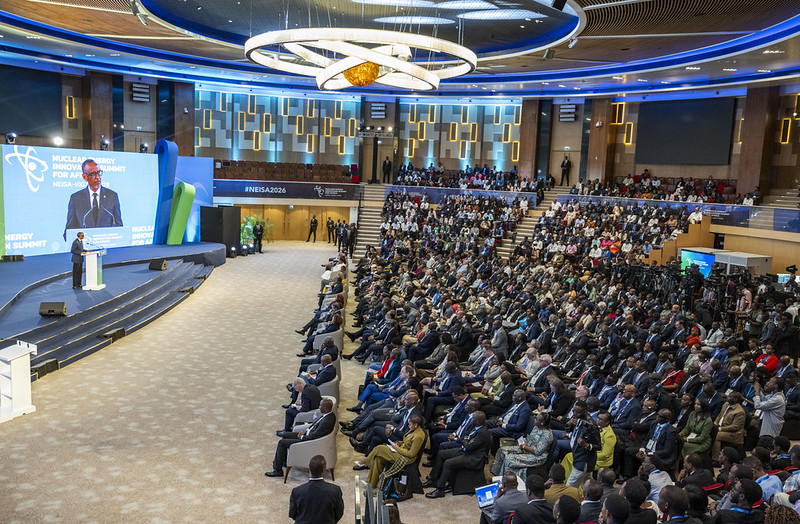
Participants in the NEISA 2026 Summit in Kigali
Two Paths to the Atom: What the Rosatom and Holtec Bring to the Table
The offerings from Moscow and Washington represent fundamentally different technological and structural philosophies:
The Russian Blueprint (Rosatom): Brings an infrastructure-heavy, state-backed model. The partnership focuses on institutional capacity building and the realization of a modern Centre for Nuclear Science and Technology, featuring a multi-purpose, pool-type research reactor. This framework provides Rwanda with a robust pipeline for human resource development, allowing local engineers to train directly within Russian institutions to master the fundamentals of nuclear physics, material science, and medical radioisotope production.
The American Blueprint (Holtec International): Offers a private-sector-driven model focused on commercial innovation and rapid scalability. Through strategic government memoranda and commercial development agreements, the U.S. is positioning its advanced SMR-300 Small Modular Reactors as the future of the Rwandan grid. The American approach prioritizes regulatory alignment, site-feasibility assessments, and flexible, walk-away-safe commercial technologies designed to deliver 24/7 baseload power to rapidly growing industrial economies without requiring massive, traditional plant footprints.
The Compounding Demand of the Digital Age
The underlying driver for this dual-track strategy is an aggressive push for rapid industrialization, a reality that President Kagame underscored when he stated that energy is “the foundation of industrial growth and competitiveness” for the continent. In the view of Rwandan policymakers, traditional power grids are fundamentally inadequate for the economic shifts already underway. Modern manufacturing, mineral processing, and advanced healthcare require an unyielding, unbroken supply of electricity that clean but intermittent sources like solar and hydro cannot achieve on their own.
This energy security becomes even more critical when looking at the global expansion of data-driven industries. The president warned that as advanced healthcare, modern manufacturing, and heavy digital infrastructure expand, the rapid explosion of artificial intelligence will drastically increase power consumption. Consequently, nations unable to satisfy this compounding demand “will struggle to compete” globally. By securing commitments from both the U.S. and Russia, Rwanda is future-proofed against this exact vulnerability, ensuring its local tech factories and data hubs have the baseload power required to anchor Africa’s digital sovereignty.
Financing the Atomic Shift: Two Distinct Economic Architectures
Funding a projected six-billion-dollar nuclear transition requires distinct economic architectures for each superpower relationship, dividing national liabilities into entirely different asset classes:
| RWANDA’S DUAL FINANCIAL TRACK |
| RUSSIAN MODEL | U.S. MODEL |
* Sovereign Export Credits * State-to-State Lending (85%) * 20-30 Year Concessional Loans * Back-loaded Repayment Grace | * Public-Private Partnerships * Blended Project Finance (EXIM/WB) * Amortized via Commercial PPAs * Off the National Balance Sheet |
When dealing with Russia, the financial model rests primarily on sovereign export credits extended directly by Moscow to the Rwandan treasury. Under this state-to-state framework, Russia typically finances up to 85% of construction costs. This creates a long-term sovereign debt structured as a 20- to 30-year loan with concessional interest rates hovering around 3%. Crucially, these agreements feature deferred grace periods, meaning interest accrual and repayments begin only after the nuclear facilities are online and generating economic value.
Conversely, the American model avoids direct sovereign lending, shifting the debt burden onto a commercial public-private partnership framework. Engagements with American entities are financed through special purpose project vehicles that blend domestic equity with international development capital. This model leverages commercial loans backed by the Export-Import Bank of the United States alongside nuclear infrastructure financing from global institutions like the World Bank. This commercial debt features flexible, market-driven interest rates tied to project delivery milestones, carrying typical amortization tenors of 15 to 25 years. This ensures the debt is amortized through long-term power purchase agreements (PPAs) rather than resting entirely on the national balance sheet.
Navigating the Friction
An inherent friction exists between these two approaches, as Washington explicitly frames its civil nuclear partnerships as a mechanism to counter the influence of foreign state-owned enterprises. U.S. diplomats consistently emphasize that their model promotes the highest standards of safety and financial independence—an implicit critique of the long-term state dependencies often created by Moscow’s fuel supply and financing structures.
Despite this underlying tension, direct conflict has been avoided on the ground because the Rwandan government maintains unyielding ownership over its national agenda. By treating nuclear energy strictly as an essential infrastructure requirement for grid stability, industrial growth, and digital sovereignty, the country forces both powers to interact with it on a purely transactional, contractual basis. As long as the framework remains transparent, safe, and aligned with global standards, Kigali can continue to extract maximum technological value from both rivals without allowing either to dictate its broader sovereign future.
Deep-Dive Cost Breakdowns for the Rwandan Nuclear Projects
Summit Proceedings and Policy Frameworks (The $6 Billion Capital Envelope)
The Nuclear Energy Innovation Summit for Africa (NEISA 2026, Kigali): The overarching strategic framework and the $6 billion long-term transition envelope are derived from policy briefings and expert panels hosted by the Rwanda Atomic Energy Board (RAEB). Specifically, the reality that “no African newcomer is financially ready for immediate cash outlays” and must utilize partner-backed financing mechanisms was outlined by regional energy advisers.
The World Bank Policy Reversal (June 2025): The structural premise of the American track—utilizing multilateral development finance blended with commercial loans—is rooted in the historic June 2025 decision by the World Bank to reverse its decades-long ban on nuclear energy projects. This shift, highlighted by IAEA Director General Rafael Grossi at NEISA, fundamentally altered the risk profile for Western institutional capital entering Africa’s nuclear space.
Rosatom Financed Tracking (The Russian State-to-State Baseline)
The 85% Sovereign Credit Model: The structural financing profile for the Russian track uses the exact economic architecture deployed by Rosatom for its primary African newcomer blueprints, notably Egypt’s El Dabaa facility. Under these bilateral agreements, the Russian Ministry of Finance issues a state-guaranteed export credit covering 85% of turnkey construction costs.
The CNST Asset Class: Capital cost estimates for the Centre for Nuclear Science and Technology (CNST) and its corresponding multi-purpose pool-type research reactor ($200M to $500M) are benchmarked against historical and active Rosatom civil research builds across emerging markets, where foundational capacity is prioritized over immediate commercial grid-scale megawattage.
OECD Nuclear Energy Agency and US EXIM Baselines (The American Commercial Track)
Overnight Capital Cost Benchmarks ($7,000 – $10,000 per kW): The specific cost projections for advanced Small Modular Reactors, such as Holtec International’s SMR-300 or Westinghouse’s AP-300, are grounded in the OECD Nuclear Energy Agency (NEA) Small Modular Reactor Dashboard (Third Edition, late 2025). This data outlines First-of-a-Kind (FOAK) Western SMR construction estimates ranging between $6.4 million and $10 million per Megawatt-electric (MWe). For a 300 MW facility, this yields the $2.1 billion to $3 billion bracket.
US EXIM Bank Project Finance Frameworks: The off-balance-sheet architecture assigned to the U.S. track reflects the standard financing templates of the Export-Import Bank of the United States (EXIM) for civil nuclear technology exports. This framework utilizes loan guarantees and Special Purpose Vehicles (SPVs) backed by commercial Power Purchase Agreements (PPAs) to amortize the debt without adding direct sovereign liabilities to a developing nation’s central treasury.
These institutional reference points cleanly separate the state-to-state liability of the Russian model from the market-driven, off-balance-sheet architecture of the American commercial track, giving your feature a highly accurate financial foundation.
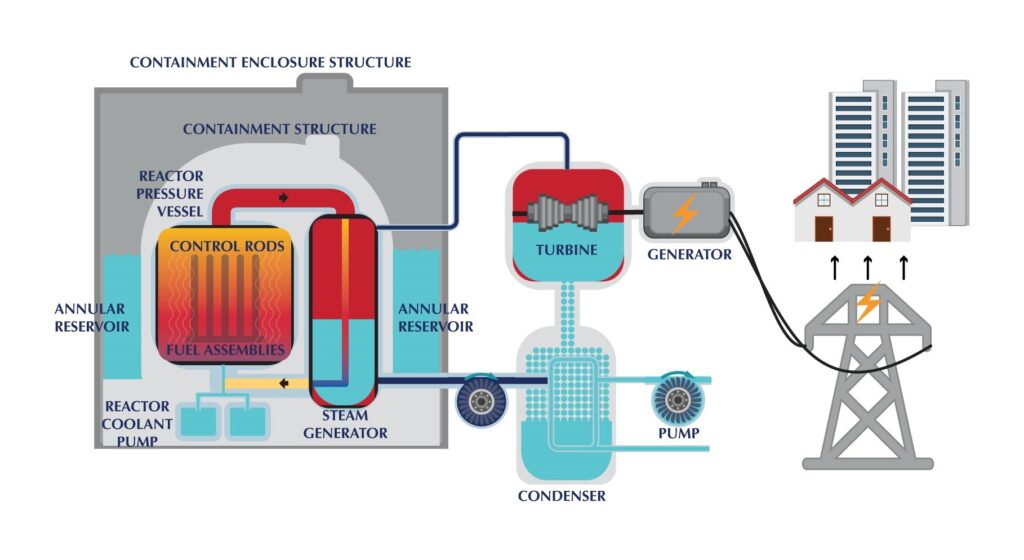
Simple schematic of Holtec SMR-300
Engineering the Architecture: The Structural Blueprints of Rwanda’s Nuclear Future
The physical reality of Rwanda’s dual nuclear strategy is etched into two wildly divergent engineering blueprints. While Russia is delivering an open, pool-type scientific engine designed to generate intense neutron fields for industrial, mining, and medical research, the United States is deploying a sealed, walk-away-safe power engine built to feed heavy industrial grids. Examining the technical layout, core mechanics, and containment designs reveals exactly how these systems operate on a purely structural level.
The Russian Engineering Design: Rosatom’s VVR-KN Research Reactor
The blueprint submitted by Russia’s state nuclear corporation, Rosatom, for the Centre for Nuclear Science and Technology is a classic pool-type heterogenous research reactor, historically designated within the VVR-KN engineering family. Operating at a thermal capacity of up to 10 megawatts, this system is not designed to turn a turbine or generate electricity, but rather to act as a high-flux neutron factory. The core sits suspended at the bottom of a deep, open-topped steel-lined concrete pool filled with demineralized light water, which acts simultaneously as the primary coolant, the neutron moderator, and the biological shield for technicians working directly above the pool surface.
+-------------------------------------------------------+
|            Rosatom VVR-KN Pool Reactor                |
|                                                       |
|   [ Open Water Pool / Biological Shielding ]          |
|                       |                               |
|       +---------------+---------------+               |
|       |   Beryllium Neutron Reflector |               |
|       |   +-----------------------+   |   ======>     |
|       |   |  Low-Enriched Fuel    |   |  Experimental |
|       |   |  Assemblies (LEU)     |   |  Beam Channels|
|       |   +-----------------------+   |   ======>     |
|       |                               |               |
|       +-------------------------------+               |
+-------------------------------------------------------+
Internally, the core configuration is exceptionally compact, holding between 26 and 45 specialized fuel assemblies utilizing low-enriched uranium optimized to comply with global non-proliferation standards.
The American Engineering Design: Holtec’s SMR-300 Power Reactor
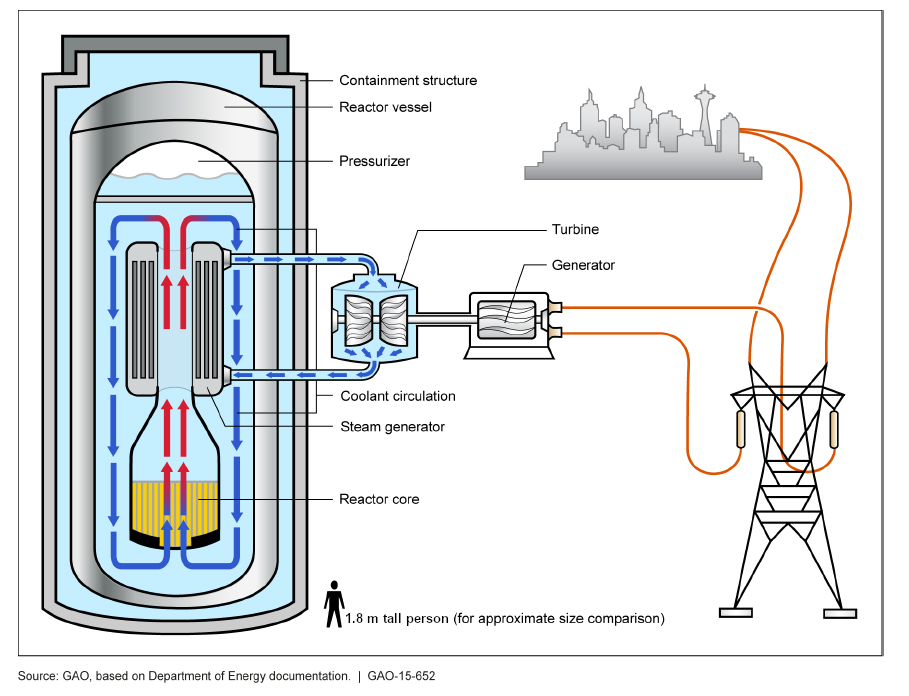
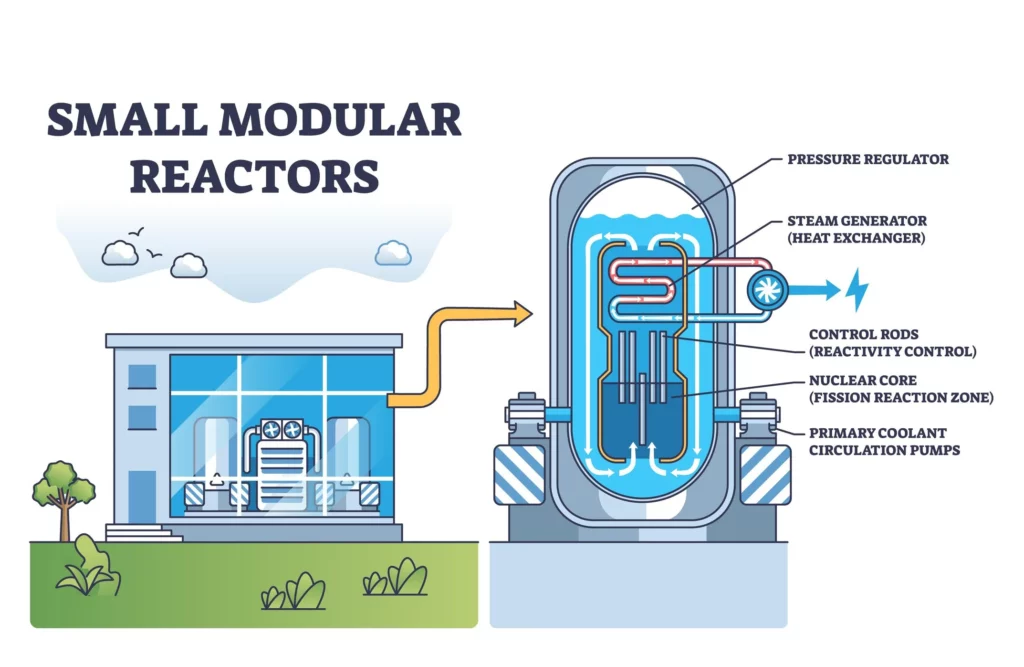
The United States design, advanced by Holtec International, is a commercial-grade, Generation III+ Pressurized Light Water Reactor delivering a net electrical output of over 300 megawatts from a 1000-megawatt thermal core.
+-------------------------------------------------------+
|            Holtec SMR-300 Power Reactor               |
|                                                       |
|    +---------------------------------------------+    |
|    | Outer Containment Enclosure Structure (CES) |    |
|    |    +-----------------------------------+    |    |
|    |    | Demineralized Water Sink          |    |    |
|    |    |    +-------------------------+    |    |    |
|    |    |    | Inner Steel Containment |    |    |    |
|    |    |    |                         |    |    |    |
|    |    |    |   [Integrated Pressurizer]    |    |    |
|    |    |    |              |          |    |    |    |
|    |    |    |   [Once-Through Steam Gen]    |    |    |
|    |    |    |              |          |    |    |    |
|    |    |    |   [Spent Fuel Pool (SFP)]     |    |    |
|    |    |    |              |          |    |    |    |
|    |    |    |   [Reactor Pressure Vessel]   |    |    |
|    |    |    +-------------------------+    |    |    |
|    |    +-----------------------------------+    |    |
|    +---------------------------------------------+    |
+-------------------------------------------------------+
The safety containment blueprint is engineered around a unique dual-wall configuration. An inner, heavy-gauge steel containment vessel houses the primary reactor components, while an outer, missile-resistant concrete Containment Enclosure Structure provides the external shield. The annular space between these two walls is filled with a massive volume of demineralized water, creating an integrated, permanent Annular Reservoir. If a severe accident occurs and all external power is lost, this reservoir acts as a completely passive, gravity-driven ultimate heat sink. The water absorbs the core’s decay heat and evaporates over an indefinite coping period, requiring zero alternating-current electricity, zero external water pumps, and zero human intervention.
Furthermore, Holtec’s layout integrates the Spent Fuel Pool directly inside the primary steel containment structure right next to the reactor pressure vessel.
Technical Comparison of the Systems
| Technical Specification | Russian Rosatom Blueprint (VVR-KN / CNST) | American Holtec Blueprint (SMR-300) |
| Reactor Category | Open-Pool Thermal Research Reactor | Pressurized Light Water Power Reactor (PWR) |
| Energy Output | 10 Megawatts Thermal ($10\text{ MW}_{th}$) / Zero Electricity | 1000 Megawatts Thermal ($1000\text{ MW}_{th}$) / ~320 Megawatts Electrical |
| Cooling Mechanism | Forced or natural convection within an open water pool | Closed two-loop system with vertical pumps and air-cooling options |
| Safety Philosophy | Deep water shielding, manual and automated control rods | Fully passive, gravity-driven heat rejection via an Annular Reservoir |
| Fuel Configuration | Low-Enriched Uranium assemblies surrounded by a beryllium reflector | Standard commercial light water fuel assemblies enclosed inside containment |
| Primary Function | Medical radioisotopes, neutron beam analysis, academic training | 24/7 industrial baseload electricity, desalination, hydrogen production |
The Architectural Divergence: The structural layout highlights that Rwanda is not buying competing versions of the same technology. The Russian design is an open, accessible scientific instrument meant to be adjusted, probed, and used for hands-on national training. The American design is a sealed, heavily protected industrial battery designed to sit quietly on a small footprint and reliably pump power into a modernizing grid.